


Last reviewed: November 24, 2026 · Based on guidance from the American Academy of Pediatrics (AAP), CDC and Seattle Children’s Hospital.
Quick answer: To care for a newborn, feed on demand (about 8 to 12 times in 24 hours), put your baby on their back to sleep in their own crib or bassinet every time, give sponge baths until the umbilical cord stump falls off, keep the cord dry, always support the head and neck, and never shake your baby. Use a rear-facing car seat for every ride and go to the first check-up within the first week. Call your doctor right away for a rectal temperature of 100.4°F (38°C) or higher in the first 3 months.
Caring for a newborn can feel overwhelming at first. The good news is that the basics are simple, and you will repeat them many times a day. This guide covers the 10 essential steps of newborn care, a quick daily checklist, the most important don’ts and when to call the doctor.
Newborn Care at a Glance
| Care area | What to do | How often |
|---|---|---|
| Feeding | Breast milk or formula only, on demand | About 8 to 12 times in 24 hours |
| Sleep | On the back, in a bare crib or bassinet, in your room | Every sleep, day and night |
| Diapers | Change wet and dirty diapers, clean gently | About 8 wet diapers a day by day 3 to 5 |
| Bathing | Sponge baths until the cord falls off | About 3 baths a week is enough |
| Cord care | Keep it clean and dry, fold the diaper below it | Check at every diaper change |
| Tummy time | Awake and supervised, on a firm surface | 2 to 3 short sessions a day |
| Check-ups | First pediatric visit | Within the first week |
Step 1: Feed on Demand
According to the CDC, most babies breastfeed about 8 to 12 times in 24 hours, and in the first days they may want to eat as often as every 1 to 3 hours. Newborns need to eat often, so watch for hunger cues such as rooting, lip licking, bringing hands to the mouth and restlessness. Crying is a late sign of hunger. Burp your baby during and after feeds. Our guide on how often a newborn eats has more detail, and if your baby spits up a lot, see how long to keep a baby upright after feeding.
Give only breast milk or formula. No water, juice or other foods until around 6 months. The CDC says babies who get breast milk, alone or with formula, need a vitamin D supplement of 400 IU every day, starting shortly after birth. Babies who drink only formula usually don’t need one once they take 32 ounces or more a day. Ask your pediatrician which product to use.
Step 2: Follow Safe Sleep, Every Time
Newborns sleep a lot, often 14 to 17 hours a day in short stretches. The AAP recommends:
- Place your baby on their back for every sleep
- Use a firm, flat, non-inclined crib or bassinet with only a fitted sheet, and no pillows, bumpers, blankets or toys
- Room-share, but don’t bed-share, for at least the first 6 months
- Don’t let your baby sleep in a swing, car seat or on a sofa
- Offer a pacifier at sleep time once breastfeeding is going well
Read our full guide to reducing the risk of SIDS. When you are ready for a rough daily rhythm, our free baby sleep schedule tool shows typical sleep, naps and awake times by age, starting from newborn.
Step 3: Change Diapers and Watch the Output
Wet and dirty diapers tell you your baby is getting enough milk. The AAP says that within 3 to 5 days, both breastfed and bottle-fed babies wet about 8 diapers every 24 hours. Clean the diaper area at every change with water or fragrance-free wipes, wipe front to back, and let the skin dry before closing the new diaper. Poop patterns vary a lot, especially in breastfed babies. Our guide to how often a baby should poop explains what is normal.
Step 4: Keep Your Baby Clean, Gently
Give sponge baths until the umbilical cord stump falls off. After that, the AAP says three baths a week during the first year may be enough. Use about 2 inches of water that feels warm, not hot, on the inside of your wrist or elbow, a mild, fragrance-free baby cleanser, and never leave your baby alone in the bath, even for an instant. Avoid baby powder, which can be breathed in. Here is our step-by-step guide on how to bathe a newborn with the umbilical cord still on.
Step 5: Care for the Umbilical Cord
Keep the cord stump clean and dry, and fold the diaper below it. It usually falls off on its own within 1 to 3 weeks. Don’t pull it. Call your doctor if the skin around it gets red, swollen or smelly, or if it bleeds.
Step 6: Look After Their Skin
Most newborns don’t need lotion. Peeling skin in the first weeks is normal. If skin is dry, use a small amount of fragrance-free, hypoallergenic moisturizer. Ask your doctor about any rash.
Step 7: Dress Them Comfortably
Choose soft, breathable fabrics such as cotton, with no tight elastic or scratchy seams. Dress your baby in about one more layer than you’re wearing. For sleep, use a sleep sack or light layers instead of blankets, and watch for overheating, such as sweating or a hot chest.
Step 8: Handle Gently, Soothe Crying and Never Shake
Always support your baby’s head and neck. Give your baby short, supervised tummy time while awake. The AAP suggests starting the day you come home from the hospital, 2 to 3 times a day for 3 to 5 minutes, and working up to 15 to 30 minutes a day by 7 weeks.
Crying, even long periods of crying that won’t stop, is normal in young babies. Never shake a baby. It can cause serious brain injury. The CDC advises that if crying becomes too much, you put your baby in a safe place, walk away to calm down, and check on them every 5 to 10 minutes. Ask a partner, friend or relative to take over when you need a break.
Step 9: Keep the Air Clean and Travel Safely
Keep your home and car smoke-free, including vaping. Keep your baby’s room at a comfortable temperature and avoid drafts. Short walks outdoors are fine, with your baby dressed for the weather and kept out of direct sun.
Use a rear-facing car seat for every ride, installed correctly. Carriers and slings are great for closeness, as long as your baby’s face is visible and their chin is off their chest. Don’t leave your baby sleeping in a car seat or carrier once you’re home.
Step 10: Go to Check-Ups and Know When to Call
The AAP says your baby’s first pediatric visit should be scheduled within the first week after birth. Early check-ups look at weight, feeding and jaundice, and vaccines start on schedule. If you leave your baby with a grandparent or sitter, our free baby handover sheet helps you write down feeds, naps and emergency numbers.
When to Call the Doctor
Call your doctor right away if your baby:
- Has a rectal temperature of 100.4°F (38°C) or higher under 3 months, as Seattle Children’s Hospital advises
- Has trouble breathing, or blue or gray lips
- Isn’t feeding well or has fewer wet diapers than expected
- Has yellow skin or eyes that are spreading or getting deeper
- Is very sleepy, floppy or hard to wake
Ask for help when you need it. Every new parent does.
A Simple Daily Newborn Care Checklist
- Feed when your baby shows hunger cues, about 8 to 12 times a day
- Back to sleep, in a bare crib or bassinet, for every nap and night
- Check diapers and count the wet ones
- Clean the cord area and keep it dry
- Short tummy time sessions while awake and watched
- Vitamin D drops if your baby gets breast milk
- Rest when you can, and accept help
The Don’ts of Newborn Care
- Don’t use harsh soaps, fragrances or baby powder.
- Don’t dress your baby in tight or scratchy clothes, or overbundle them.
- Don’t pick your baby up without supporting their head and neck.
- Don’t give anything other than breast milk or formula, and never honey before 12 months.
- Don’t let your baby sleep in a car seat, swing or carrier, or leave them in a car seat for long periods.
- Don’t bed-share or sleep with your baby on a sofa or armchair.
- Don’t smoke or vape around your baby.
- Don’t leave your baby alone in the bath or on a changing table.
From a Dad of Two
With our two kids, the changing table was one of the things we used every single day, and it was very useful. We used a baby carrier mostly with our first child. Sleep was the hardest part of the first weeks for us, especially with our first child, who needed a lot of holding before falling asleep, and car rides. Our second fell asleep easily. Both kids were breastfed, each for about 14 months, and both got vitamin D drops, as our doctor instructed. Every baby is different, so don’t worry if yours doesn’t match a book. Just keep the safety rules the same: once home, move a sleeping baby from the car seat to their crib or bassinet, on their back.
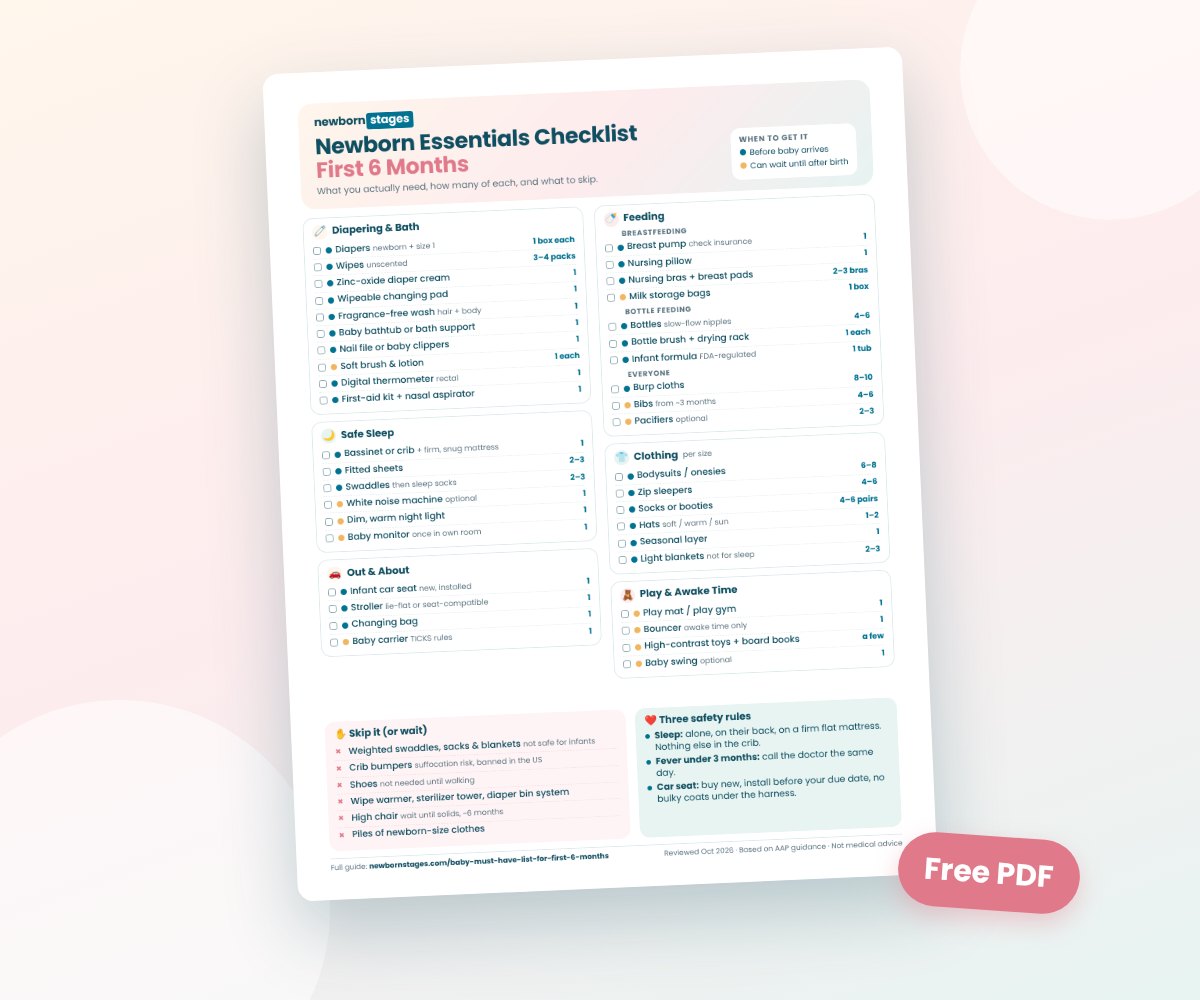
Still shopping? See our baby must-have list for the first 6 months and our step-by-step guide to your baby’s first days at home.
Frequently Asked Questions About Newborn Care
What are the most important things to do for a newborn?
Feed on demand, put your baby on their back to sleep in a bare crib or bassinet, keep the cord clean and dry, support the head and neck, never shake your baby, and use a rear-facing car seat. Go to the first check-up within the first week.
How often should a newborn eat?
Most newborns eat about 8 to 12 times in 24 hours. In the first days, breastfed babies may want to eat every 1 to 3 hours. Feed when you see hunger cues rather than by the clock.
How often should I bathe my newborn?
Use sponge baths until the cord stump falls off. After that, the AAP says three baths a week in the first year may be enough. Clean the diaper area at every change.
How many wet diapers should a newborn have?
By day 3 to 5, both breastfed and bottle-fed babies usually wet about 8 diapers every 24 hours. Fewer wet diapers than expected is a reason to call your doctor.
When should a newborn start tummy time?
You can start the day you bring your baby home. Begin with 2 to 3 sessions of 3 to 5 minutes a day while your baby is awake and watched, and build up to 15 to 30 minutes a day by about 7 weeks.
When should I call the doctor about my newborn?
Call right away for a rectal temperature of 100.4°F (38°C) or higher in the first 3 months, trouble breathing, poor feeding, fewer wet diapers, spreading yellow skin, or a baby who is very sleepy or hard to wake.
The Bottom Line
Newborn care comes down to a few basics: feed on demand, follow safe sleep every time, watch the diapers, keep your baby clean, warm and smoke-free, handle them gently, use a car seat, and go to check-ups. Trust yourself, ask for help, and call your pediatrician whenever you’re worried.
This article is for general information and isn’t a substitute for medical advice. Always contact your pediatrician with questions about your baby’s health.
9 Sources
Newborn Stages uses trusted sources, including government health agencies, children’s hospitals and pediatric organizations, to support the facts in our articles. Read our editorial policy to learn how we research, fact-check and keep our content accurate.
- HealthyChildren.org, American Academy of Pediatrics. How to keep your sleeping baby safe: AAP policy explained.
- Seattle Children’s Hospital. Fever.
- Centers for Disease Control and Prevention. How Much and How Often to Breastfeed.
- Centers for Disease Control and Prevention. Vitamin D.
- HealthyChildren.org, American Academy of Pediatrics. Your Newborn’s First Week.
- HealthyChildren.org, American Academy of Pediatrics. Bathing Your Baby.
- HealthyChildren.org, American Academy of Pediatrics. Back to Sleep, Tummy to Play.
- Centers for Disease Control and Prevention. About Abusive Head Trauma.
- Mayo Clinic. Shaken baby syndrome.