

This post contains affiliate links. If you buy through them, we may earn a small commission at no extra cost to you. Learn more.
Last reviewed: November 3, 2026 · Based on safety guidance from the AAP, Children's Hospital of Philadelphia and the US EPA, plus manufacturer specs and published reviews.
Quick answer: The best humidifier for a baby is a cool-mist model. The American Academy of Pediatrics recommends cool mist over warm-mist humidifiers and steam vaporizers because there’s no hot water to burn a curious child. Our top pick for most nurseries is the Levoit Classic 160: quiet, easy to fill and clean, and affordable. If you want a model that doesn’t spread mineral dust, choose an evaporative one like the Honeywell HCM350 or Canopy. Whichever you buy, place it about 3 feet from the crib, keep the room at 50% humidity or less, and clean it every few days.
How we chose: we haven’t tested these humidifiers in our own home. This guide is based on research: safety guidance from the AAP, Children’s Hospital of Philadelphia (CHOP) and the US Environmental Protection Agency (EPA), manufacturer specifications, published hands-on reviews, and patterns in verified buyer reviews. We only included cool-mist models from established brands with auto shut-off. Prices change often, so check the current price before you buy.
Winter heating dries out indoor air fast, and that’s often when babies get their first colds. A stuffy nose matters more for babies than for adults, because young babies breathe mostly through their nose (see when babies start breathing through their mouth). A clean cool-mist humidifier can make the air more comfortable and help loosen mucus. Here’s what to buy, and just as important, how to use it safely.
Best Humidifiers for Baby at a Glance
| Humidifier | Best for | Type | Tank / runtime | Room size | Approx. price |
|---|---|---|---|---|---|
| Levoit Classic 160 | Best overall | Ultrasonic cool mist | 2.5 L / up to 25 hrs | Up to 219 sq ft | About $40 |
| Frida Baby 3-in-1 | Longest runtime + nightlight | Ultrasonic cool mist | 2.5 L / up to 60 hrs | Up to 320 sq ft | About $45 |
| Crane Droplet 0.5 Gal | Small nurseries | Ultrasonic cool mist | 0.5 gal / up to 24 hrs | Up to 250 sq ft | About $40–50 |
| Honeywell HCM350 | No white dust on a budget | Evaporative + UV | 1.1 gal / up to 24 hrs | Medium rooms | About $70–100 |
| Canopy Humidifier | Easiest to keep clean | Evaporative + UV | 2.5 L / up to 36 hrs | Up to 500 sq ft | About $150–160 |
Why Cool Mist Is the Safe Choice for Babies
There are two main kinds of home humidifier. Cool-mist humidifiers use room-temperature water to make a fine mist (ultrasonic models) or blow air through a wet wick (evaporative models). Warm-mist humidifiers and vaporizers boil water and release steam. Both add moisture, but steam and hot water can burn a child who pulls the unit over or gets too close, which is why the AAP and CHOP recommend cool mist for children. By the time the moisture reaches your baby’s airways, it’s at the same temperature either way, so you don’t lose anything by choosing cool mist.
Within cool mist, there’s one trade-off to know about:
- Ultrasonic models are quiet and inexpensive, but the EPA notes they can spread minerals and microorganisms from the tank into the air. With hard tap water, you’ll see this as “white dust” on furniture. Using distilled water and cleaning often solves most of it.
- Evaporative models trap minerals in a wick filter, so there’s no white dust and no visible mist. They have a gentle fan sound (some parents like it as white noise) and need replacement filters.
The 5 Best Humidifiers for Baby’s Room
1. Levoit Classic 160 – Best Overall
The Levoit Classic 160 is consistently one of Amazon’s best-selling humidifiers, and it shows up as a top nursery pick in many published reviews. It holds 2.5 liters and runs up to 25 hours on the lowest setting (about 11 hours on max). Levoit rates it below 28 dB, which is quieter than a whisper, and you can turn all the lights off so it doesn’t disturb sleep. You fill it from the top, so there’s no flipping a heavy tank over the sink, and the wide opening makes it easy to scrub. It shuts off automatically when the water runs out and comes with a 2-year warranty.
- Pros: very quiet, top-fill, easy to clean, single knob, low price
- Cons: ultrasonic, so use distilled water to avoid white dust; sized for small to medium rooms (about 219 sq ft); no built-in humidity sensor
Check the Levoit Classic 160 price on Amazon
2. Frida Baby 3-in-1 Humidifier – Best for Long Runtime
Frida Baby’s humidifier is built for nurseries. It combines a cool-mist humidifier, a color-changing nightlight and a diffuser, holds 2.5 liters and is rated for rooms up to 320 square feet. Its standout is runtime: up to 60 hours on the lowest setting, so you’re not refilling at 2 a.m. It’s top-fill, filter-free and turns off automatically when it’s empty or the tank is removed. Some buyers mention a faint hum in a very quiet room.
- Pros: very long runtime, nightlight you can switch off separately, top-fill, no filters to buy
- Cons: ultrasonic (white dust with tap water); skip the diffuser feature in a baby’s room (see the FAQ below)
Check the Frida Baby 3-in-1 price on Amazon
3. Crane Droplet 0.5 Gallon – Best for Small Nurseries
Crane is one of the best-known nursery humidifier brands, and the Droplet is its compact everyday model. The half-gallon tank covers rooms up to 250 square feet and runs up to 24 hours on low (about 15 hours on high). It has three speed settings, a lid that rotates 360 degrees so you can point the mist away from the crib and furniture, auto shut-off, and no filter. Crane sells an optional demineralization filter if your water is hard.
- Pros: compact, simple controls, adjustable mist direction, trusted brand
- Cons: smaller tank than the Levoit and Frida; bottom-fill tank is a little less convenient
Check the Crane Droplet price on Amazon
4. Honeywell HCM350 – Best Evaporative on a Budget
If you have hard water or don’t want to buy distilled water, an evaporative humidifier is the easier route. The Honeywell HCM350 passes water under a UV light and then through a wicking filter that holds on to minerals, so the moisture is invisible and there’s no white dust. It has a 1.1-gallon tank, runs up to 24 hours, has three settings and a 3-year limited warranty. Published reviews describe the fan as a low hum, similar to white noise, and note that evaporative models naturally slow down as the room gets more humid, which makes over-humidifying less likely.
- Pros: no white dust, works with tap water, long-standing model, good warranty
- Cons: bulkier; fan noise; the wick filter needs replacing regularly
Check the Honeywell HCM350 price on Amazon
5. Canopy Humidifier – Easiest to Keep Clean (Splurge)
Canopy’s big selling point is cleaning, which is where most humidifiers fail. The tank, tray, cap and grill go in the dishwasher, and the evaporative design with UV-treated water means there’s no visible mist or white dust. The 2.5-liter tank runs up to 36 hours and covers up to 500 square feet. It’s expensive, and the filter needs replacing about every six weeks, which adds to the running cost. Reviewers also mention it gets louder on the high setting.
- Pros: dishwasher-safe parts, no mist or white dust, tap-water friendly, attractive design
- Cons: highest price here, ongoing filter cost, louder on high
Check the Canopy Humidifier price on Amazon
Don’t skip a hygrometer. A small digital hygrometer (often under $15) shows the room’s actual humidity, so you know when to turn the humidifier down. None of the budget picks above has a built-in humidity sensor.
How to Choose a Humidifier for Your Baby
- Cool mist only. Avoid warm-mist and steam vaporizers in a child’s room.
- Auto shut-off. CHOP recommends a model that turns off automatically, and every pick here does.
- Right size for the room. A unit that’s too big for the room can cause condensation, which encourages mold and bacteria. Most nurseries are 100–200 square feet, so a small to medium model is plenty.
- Easy to clean. A wide opening, few nooks, or dishwasher-safe parts make it far more likely you’ll actually clean it.
- Quiet, with lights you can turn off. Look for a published noise rating and a dark mode.
- Your water. Hard tap water plus an ultrasonic humidifier means white dust. Either use distilled water or choose an evaporative model.
Safe Humidifier Setup in the Nursery
How Close Should a Humidifier Be to Baby?
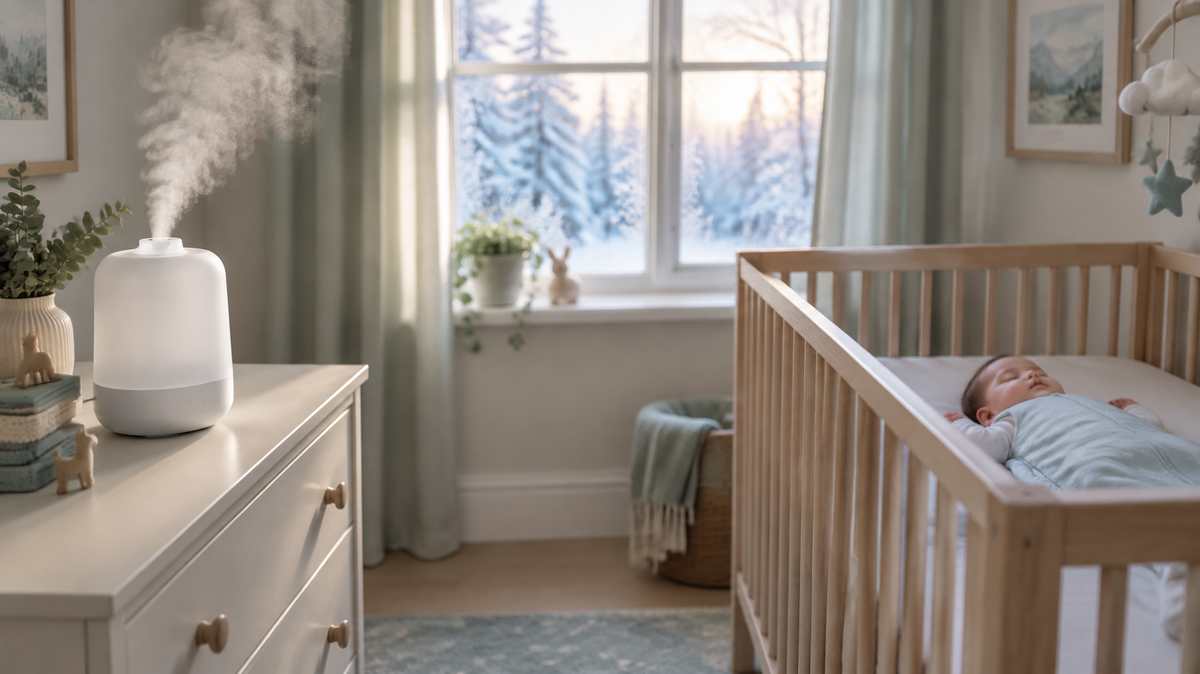
Close enough to make a difference, but out of reach. CHOP advises not placing a humidifier directly next to the crib and keeping about 3 feet between the humidifier and your child. Put it on a stable dresser or shelf, point the mist away from the crib, walls and wooden furniture, and keep the cord where your baby (or a climbing toddler) can’t pull it. As always, keep the crib itself bare: no blankets, pillows or bumpers.
Water and Humidity Level
Use distilled or filtered water. The EPA recommends water with low mineral content, such as distilled water, and advises not humidifying above 50% relative humidity, since damp air encourages mold and dust mites. Empty the tank and refill it with fresh water every day rather than topping it up.
How to Clean a Baby Humidifier
- Empty the tank and let the parts dry whenever you turn it off.
- Clean it every 2–3 days of use, following the manufacturer’s instructions. The EPA suggests a 3% hydrogen peroxide solution when the manual doesn’t specify a cleaner.
- If you use bleach or another disinfectant, rinse several times so no chemicals are released into the air.
- Replace filters on schedule, and clean and dry the unit fully before storing it for the season.
The EPA also advises stopping use and talking to your doctor if anyone has breathing symptoms that seem linked to the humidifier, even when you’re cleaning it properly.
Does a Humidifier Help a Congested Baby?
It can make your baby more comfortable. Moist air helps keep the nose from drying out and can loosen mucus, which pairs well with saline drops and gentle suction before feeds and sleep. A humidifier doesn’t treat the cause of a cold, though. For a barking cough at night, see our guide to croup in babies, and for fast breathing or a baby working hard to breathe, read our RSV warning signs. Call your pediatrician for any fever in a baby under 3 months, trouble breathing, poor feeding or fewer wet diapers. Dry winter air can also aggravate eczema; our tips on stopping eczema itching in babies can help, and if your baby sounds noisy when sleeping, see why newborns snore.
Frequently Asked Questions About Humidifiers for Babies
Is a humidifier good for babies?
A clean cool-mist humidifier can be helpful for babies, especially in winter when heating dries the air. It can make a stuffy nose more comfortable and help loosen mucus. Keep humidity at 50% or less and clean the unit every few days, because a dirty humidifier can spread mold and bacteria.
Should I use a warm or cool mist humidifier for my baby?
Use a cool-mist humidifier. The American Academy of Pediatrics recommends cool mist for children because warm-mist humidifiers and steam vaporizers use hot water that can burn a child who gets too close or tips the unit over.
How close should a humidifier be to my baby?
Not right next to the crib. Children’s Hospital of Philadelphia suggests keeping about 3 feet between the humidifier and your child. Place it on a stable surface out of reach, point the mist away from the crib, and keep the cord where your baby can’t reach it.
Can I use tap water in a baby humidifier?
Distilled or filtered water is better. Tap water contains minerals that ultrasonic humidifiers can spray into the air as white dust, and the EPA recommends low-mineral water such as distilled water. Evaporative models with a wick filter handle tap water better.
What humidity level is best for a baby's room?
Aim for about 30% to 50%. The EPA advises not humidifying above 50%, because damp air encourages mold and dust mites. A small digital hygrometer is the easiest way to check.
Can I put essential oils or Vicks in my baby's humidifier?
It’s best not to. Many humidifiers aren’t designed for oils, and strong scents and vapor rubs can irritate a baby’s airways. Vicks VapoRub, for example, isn’t meant for children under 2. Use plain water only, and ask your pediatrician before using any scented product around your baby.
How often should I clean a baby humidifier?
Empty and dry it whenever you turn it off, refill with fresh water daily, and clean it every 2 to 3 days of use following the manufacturer’s instructions. Rinse well after using any disinfectant, and replace filters on schedule.
The Bottom Line
The best humidifier for a baby is a cool-mist model with auto shut-off that’s sized for the room and easy to clean. For most families, the Levoit Classic 160 is the best balance of price, quiet and convenience. The Frida Baby 3-in-1 is great if you want a long runtime and a nightlight, the Crane Droplet suits small nurseries, and evaporative models like the Honeywell HCM350 and Canopy avoid white dust. Place it about 3 feet from the crib, keep humidity at 50% or less, use distilled water in ultrasonic models, and clean it every few days.
This article is for general information and isn’t a substitute for medical advice. Always contact your pediatrician with questions about your child’s health, and follow the manufacturer’s instructions for your humidifier.
5 Sources
Newborn Stages uses trusted sources, including government health agencies, children’s hospitals and pediatric organizations, to support the facts in our articles. Read our editorial policy to learn how we research, fact-check and keep our content accurate.
- Children’s Hospital of Philadelphia. Vaporizer or humidifier: which is best?
- US Environmental Protection Agency. Use and care of home humidifiers.
- Mayo Clinic. Cool-mist humidifiers for a child’s cold.
- Levoit. Classic 160 humidifier product specifications.
- Honeywell. HCM350 cool moisture humidifier.