






Newborn Stages
  • Home
  • Baby

    Development & Growth

    1-2 Months

    3-6 Months

    7-9 Months

    10-12 Months

    VIEW ALL

    Baby Feeding

    Breastfeeding
    Baby Food Recipes
    Bottle Feeding
    VIEW ALL

    Baby Sleep

    Sleep Problems
    Basics & Bedtime Routines
    VIEW ALL

    Baby Basics

    Newborn Daily Care
    Essentials
    Activities & Playtime
    VIEW ALL
  • Toddler

    Development & Growth

    13-18 Months

    19-24 Months

    2-3 Years

    VIEW ALL

    Toddler Feeding

    Eating & Nutrition
    Healthy Food Recipes
    Toddler Breastfeeding
    VIEW ALL

    Toddler Sleep

    Problems & Concerns
    Basics & Bedtime Routines
    VIEW ALL

    Toddler Care & Training

    Playtime & Education
    Everyday Care & Training
    VIEW ALL
  • Essentials
  • Health & Safety
    • Everyday Wellness
    • Common Health Concerns
    • Disabilities and Chronic Conditions
    • Mental Health
    • Playtime
    • Safety & First Aid
  • Gear & ProductsReviews

    Gear & Product Reviews

    Parenting Books - Courses

    Infant/Toddler Beds & Sleep Products

    Toys

    Nursing & Feeding

    Strollers & Accessories

    Car Seats & Accessories

    Health & Safety Products

    # Trending Reviews

    Dad/Partner Picks: Baby Products Men Actually Love (and Use)

    Best Under $30 Baby Toys That Feel Premium!

    Top 5 Travel Strollers of 2026 — Lightweight, Foldable & Airline-Approved!

    Mockingbird Single-To-Double Stroller Review 2023

    Newton Waterproof Crib Mattress Review

  • General Parenting
No Result
View All Result
Newborn Stages
  • Home
  • Baby

    Development & Growth

    1-2 Months

    3-6 Months

    7-9 Months

    10-12 Months

    VIEW ALL

    Baby Feeding

    Breastfeeding
    Baby Food Recipes
    Bottle Feeding
    VIEW ALL

    Baby Sleep

    Sleep Problems
    Basics & Bedtime Routines
    VIEW ALL

    Baby Basics

    Newborn Daily Care
    Essentials
    Activities & Playtime
    VIEW ALL
  • Toddler

    Development & Growth

    13-18 Months

    19-24 Months

    2-3 Years

    VIEW ALL

    Toddler Feeding

    Eating & Nutrition
    Healthy Food Recipes
    Toddler Breastfeeding
    VIEW ALL

    Toddler Sleep

    Problems & Concerns
    Basics & Bedtime Routines
    VIEW ALL

    Toddler Care & Training

    Playtime & Education
    Everyday Care & Training
    VIEW ALL
  • Essentials
  • Health & Safety
    • Everyday Wellness
    • Common Health Concerns
    • Disabilities and Chronic Conditions
    • Mental Health
    • Playtime
    • Safety & First Aid
  • Gear & ProductsReviews

    Gear & Product Reviews

    Parenting Books - Courses

    Infant/Toddler Beds & Sleep Products

    Toys

    Nursing & Feeding

    Strollers & Accessories

    Car Seats & Accessories

    Health & Safety Products

    # Trending Reviews

    Dad/Partner Picks: Baby Products Men Actually Love (and Use)

    Best Under $30 Baby Toys That Feel Premium!

    Top 5 Travel Strollers of 2026 — Lightweight, Foldable & Airline-Approved!

    Mockingbird Single-To-Double Stroller Review 2023

    Newton Waterproof Crib Mattress Review

  • General Parenting
No Result
View All Result
Newborn Stages
No Result
View All Result
Home Baby Basics Newborn Daily Care

Best First Foods for Baby Led Weaning (Starting at 6 Months)

Written by: Danis
May 4, 2026
in Newborn Daily Care
Best First Foods for Baby Led Weaning (Starting at 6 Months)
Share on FacebookShare on TwitterShare on PinterestEmail

Baby led weaning sounds straightforward in principle: skip the purees, hand your baby soft pieces of food, and let them figure it out.

In practice, it can feel both exhilarating and terrifying – especially when you watch a small person stuff a piece of broccoli into their mouth for the first time.

The good news is that babies are far more capable than they look when given the right foods in the right form.

Here is everything you need to get started safely and confidently.

What Is Baby Led Weaning?

Baby led weaning (BLW) is an approach to introducing solid foods that skips purees entirely and instead offers babies soft, appropriately-sized pieces of whole food from the very start.

Rather than being spoon-fed by a caregiver, the baby self-feeds from the beginning, exploring textures, flavours, and the mechanics of eating entirely on their own terms.

BLW is typically started at around 6 months and is always done alongside continued breast milk or formula, which remains the primary source of nutrition well into the second half of the first year.

For a full overview of feeding needs at 6 months including milk volumes, see our guide on how much a 6 month old should eat.

Is Baby Led Weaning Safe?

When done correctly with appropriately prepared food, yes. The American Academy of Pediatrics supports self-feeding as part of a healthy approach to introducing solids.

Research has not found BLW to carry a greater choking risk than spoon feeding when food is properly prepared.

The critical factor is always the texture and shape of the food.

Is Your Baby Ready? Signs to Look For

  • Sits upright with minimal support and holds their head steadily
  • Has good overall head and neck control
  • Shows clear interest in food – watching others eat, reaching toward plates
  • Has lost the tongue-thrust reflex – does not automatically push food out with their tongue
  • Is at or around 6 months of age

The Best First Foods for Baby Led Weaning

Vegetables

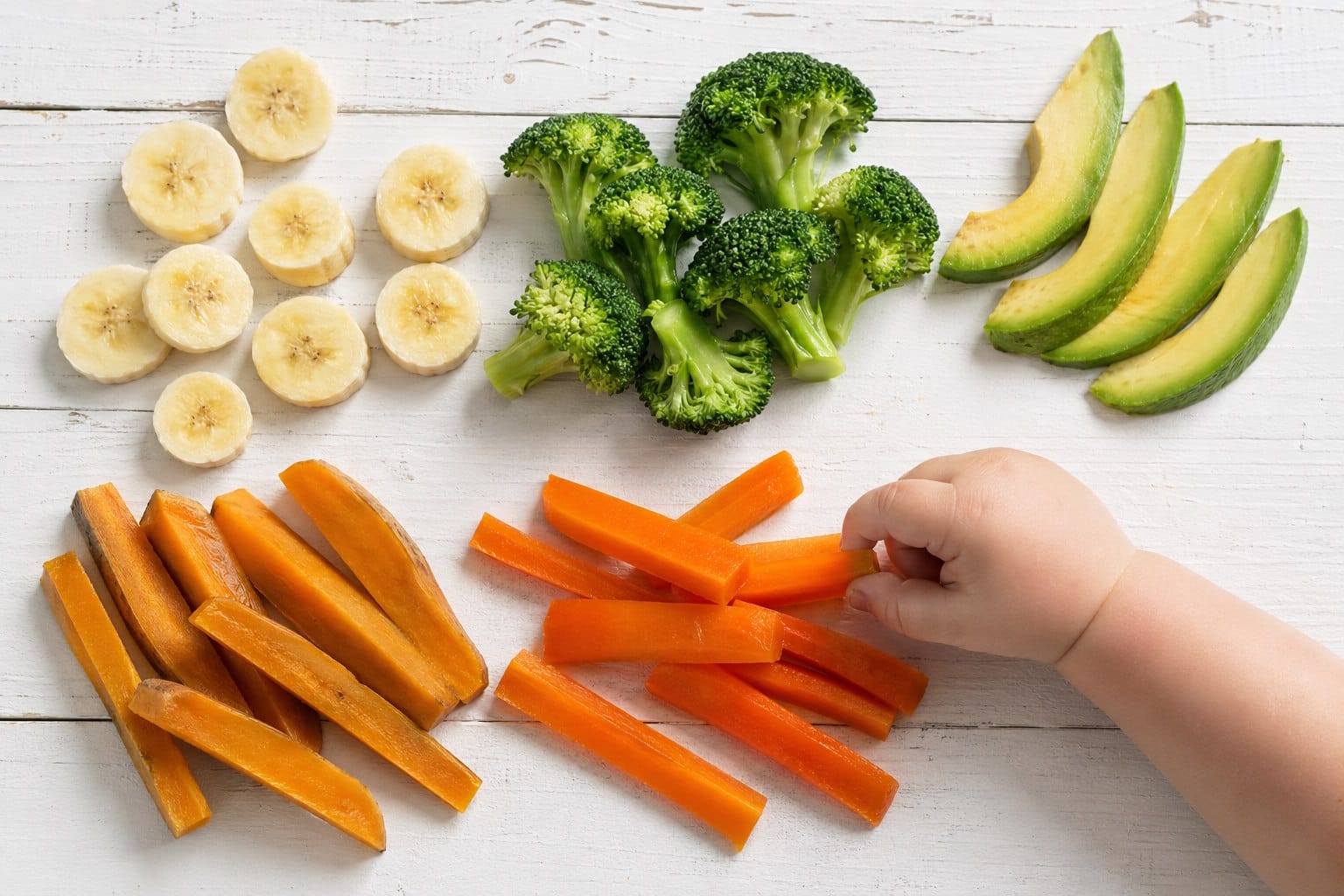
  • Steamed broccoli florets  large enough to hold like a handle, soft enough to squish easily
  • Steamed carrot sticks – must be soft enough to squish between your fingers before offering
  • Roasted sweet potato wedges – naturally soft when well cooked
  • Steamed courgette or zucchini batons
  • Soft-cooked green beans

Fruits

  • Ripe banana – halved lengthwise, or leave some peel on as a grip aid
  • Ripe avocado wedges – roll in ground oats or finely crushed crackers for better grip
  • Soft ripe pear or peach – peeled, in wedges
  • Ripe mango slices – naturally soft and easy to grip

Protein

  • Strips of well-cooked, moist chicken or turkey – dry meat is a choking hazard
  • Flaked salmon or white fish – always check carefully for bones
  • Well-cooked egg – scrambled or omelette cut into strips are easiest
  • Soft lentils or well-cooked beans served on a preloaded spoon or mixed into other food

Grains and Other

  • Toast fingers with a thin spread of nut butter, mashed avocado, or hummus
  • Soft-cooked pasta shapes
  • Porridge or oatmeal served on a preloaded spoon

For recipe ideas that incorporate these ingredients, browse our baby food recipes section.

How to Prepare Food for Baby Led Weaning

The most important rule in BLW food preparation is the squish test: food must be soft enough that you can squish it easily between your thumb and index finger.

If you cannot squish it, it is not safe for your baby. This single check prevents the majority of choking risks associated with BLW.

Shape also matters, particularly in the early months. Before around 9 months, most babies have not yet developed the pincer grasp needed to pick up small pieces.

Offer food in long, chip-sized strips that your baby can hold in their fist with some sticking out of the top.

Once the pincer grasp develops – typically between 8 and 10 months – you can begin offering smaller pieces.

For more on the pincer grasp milestone and when to expect it, see our baby development milestone guides.

Gagging vs Choking: The Most Important Thing to Understand

Gagging looks alarming and sounds dramatic – retching, watering eyes, reddening face. But it is actually a safety mechanism, not a danger sign.

Babies have a gag reflex positioned much further forward in the mouth than adults, which means food is pushed forward and out before it can become a problem.

Gagging resolves quickly without intervention and is a normal part of learning to eat.

Choking is completely different and is silent. A choking baby cannot cry, cough, or make noise.

This is a medical emergency requiring immediate action.

Before starting BLW, it is strongly recommended that all caregivers learn infant first aid including how to respond to a choking baby.

The American Red Cross offers infant CPR and choking response training both in person and online.

Foods to Avoid Under 12 Months

  • Honey – risk of infant botulism, avoid strictly until after the first birthday
  • Whole nuts – choking hazard; nut butters in thin spreads are fine if no allergy risk
  • Raw hard vegetables and whole round fruits like grapes – always cut grapes lengthwise into quarters
  • Added salt or sugar
  • Cow’s milk as a main drink
  • Low-fat foods – babies need full-fat nutrition for brain development

Frequently Asked Questions

Can I combine BLW with purees?

Yes, absolutely. A mixed approach – offering finger foods at some meals and purees at others – is completely valid and works well for many families. There is no rule that it must be one or the other.

My baby plays with the food but does not seem to eat any of it. Is that okay?

Yes. In the early weeks of BLW, exploration is the entire point. Touching, squishing, smelling, and occasionally mouthing food is all valuable learning. Milk is still providing all the nutrition – food at this stage is about education, not calories.

When will my baby start eating meaningful amounts?

Most babies do not eat significant quantities of solid food until 8 to 10 months. Before that, the messes are large and the intake is small. This is completely normal.

The Bottom Line

Baby led weaning is a wonderful approach to introducing solids when done with appropriate preparation and realistic expectations.

Start soft, start simple, and always supervise mealtimes closely.

For more on all things baby feeding, browse our baby feeding section.


Sources:

American Academy of Pediatrics — Starting Solid Foods

American Red Cross — Infant CPR and Choking Response

CDC — When to Introduce Solid Foods

ShareTweetPinSend

Follow Newborn Stages on Google News

Danis

Father of two (a 9-year-old boy and a 5-year-old girl) and the founder of Newborn Stages. I built this site because I couldn't find the clear, honest answers I needed as a new dad. Every article is written from real experience and careful research. Researching and writing about baby and toddler development since 2016.

Previous Post

How Much Should a 6 Month Old Eat? A Simple Daily Guide!

Next Post

When Do Babies Recognize Their Name?

You Might Also Like

How Much Should a 6 Month Old Eat? A Simple Daily Guide!
Newborn Daily Care

How Much Should a 6 Month Old Eat? A Simple Daily Guide!

April 29, 2026
Why Does My Baby Only Sleep When Held? (And How to Break the Habit)
Newborn Daily Care

Why Does My Baby Only Sleep When Held? (And How to Break the Habit)

April 28, 2026
Why Is My 4 Month Old Drooling So Much? (Is It Teething?)
Newborn Daily Care

Why Is My 4 Month Old Drooling So Much? (Is It Teething?)

April 27, 2026
How Early Can a Newborn Baby Turn from Belly to Back?
Everyday Care & Training

How Early Can a Newborn Baby Turn from Belly to Back?

September 8, 2025 - Updated on October 3, 2025
prds21a
Newborn Daily Care

How Soon Until I Can Take My Newborn for a Walk Outside?

July 9, 2025 - Updated on October 3, 2025
When to Worry About Baby Teeth Not Coming In?
Newborn Daily Care

When to Worry About Baby Teeth Not Coming In?

March 27, 2025

Leave a Reply Cancel reply

Your email address will not be published. Required fields are marked *

I agree to the Terms & Conditions and Privacy Policy.

As seen on

Newborn Stages offers authentic and expert parenting tips and tricks that will make your life easier.  Our mission is to educate, inspire, and uplift new parents. Newborn Stages is here to ensure new parents have all the information they need to make the right choices.
  • About us
  • Contact us
  • Advertise
  • Write for us
  • Sitemap
  • Privacy Policy
  • Terms & Conditions
  • Disclaimer
  • Affiliate Disclosure
Facebook-f Instagram

Kindly take note that all the information is for educational purposes only and not a substitute for professional health services.

  • Essentials
  • Development Stages
  • Feeding
  • Sleeping
  • Health & Safety
  • Product Reviews
©2026 www.newbornstages.com. All Rights Reserved.
No Result
View All Result
  • Home
  • Baby
    • Baby Development
      • 1-2 Months
      • 3-6 Months
      • 7-9 Months
      • 10-12 Months
    • Baby Feeding
      • Breastfeeding
      • Bottle Feeding
      • Baby Food Recipes
    • Baby Sleep
      • Sleep Problems
      • Bedtime Routines & Sleep Basics
    • Baby Basics
      • Newborn Daily Care
      • Activities & Playtime
  • Toddler
    • Toddler Development
      • 13-18 Months
      • 19-24 Months
      • 2-3 Years
    • Toddler Sleep
      • Basics & Bedtime Routines
      • Problems & Concerns
    • Toddler Feeding
      • Healthy Food Recipes
      • Eating & Nutrition
      • Toddler Breastfeeding
    • Toddler Care & Training
      • Everyday Care & Training
      • Playtime & Education
  • Essentials
  • Health & Safety
    • Common Health Concerns
    • Disabilities and Chronic Conditions
    • Everyday Wellness
    • Mental Health
    • Safety & First Aid
  • Gear & Products
    • Parenting Books – Courses
    • Infant & Toddler Beds & Sleep products
    • Toys
    • Nursing & Feeding
    • Health & Safety
    • Strollers & Accessories
    • Car Seats & Accessories
  • General Parenting

© 2022 www.newbornstages.com. All Rights Reserved.