

Last reviewed: October 28, 2026 · Based on guidance from the American Academy of Pediatrics, the CDC and Cleveland Clinic.
Quick answer: Most babies start crawling between 7 and 10 months, according to the American Academy of Pediatrics. Some begin as early as 6 months, others closer to 11 months, and a few skip crawling altogether and go straight to scooting, cruising or walking. That’s usually fine as long as your baby is moving both sides of the body equally and reaching other milestones, like sitting on their own by 9 months. You can help with daily tummy time, plenty of floor play and toys placed just out of reach.
Crawling is one of the most exciting milestones, and one of the most worried-about. If your friend’s baby was crawling at 6 months and yours is still happily sitting at 9 months, it’s natural to wonder if something is wrong. This guide explains when babies usually crawl, the different types of crawling, signs your baby is about to crawl, how to encourage it, and when it’s worth talking to your pediatrician.
When Do Babies Start Crawling?
Most babies master crawling between 7 and 10 months, according to the AAP’s HealthyChildren.org. Babies often rock back and forth on their hands and knees first, and many push themselves backward before they figure out how to go forward.
The normal range is wide. “One baby may crawl at 7 months, and another might not crawl until closer to 11 months. Both are OK,” a pediatrician told Cleveland Clinic. In a large World Health Organization study, babies started hands-and-knees crawling anywhere between about 5 and 13.5 months.
Babies born early often reach motor milestones later. Pediatricians usually use a premature baby’s adjusted age (counted from the due date) when checking milestones.
Typical Movement Timeline
| Age (approx.) | What many babies do |
|---|---|
| 4–6 months | Roll over, push up on straight arms during tummy time |
| 6–7 months | Sit with little or no support, roll to get places |
| 7–8 months | Rock on hands and knees, belly crawl or scoot |
| 7–10 months | Crawl on hands and knees |
| 9–12 months | Pull up to stand, cruise along furniture |
| Around 12 months | First steps (earlier or later is normal) |
See our month-by-month guides for 8 month milestones and 9 month milestones for everything else your baby is learning.
Types of Crawling
There’s no single “right” way to crawl. Common styles include:
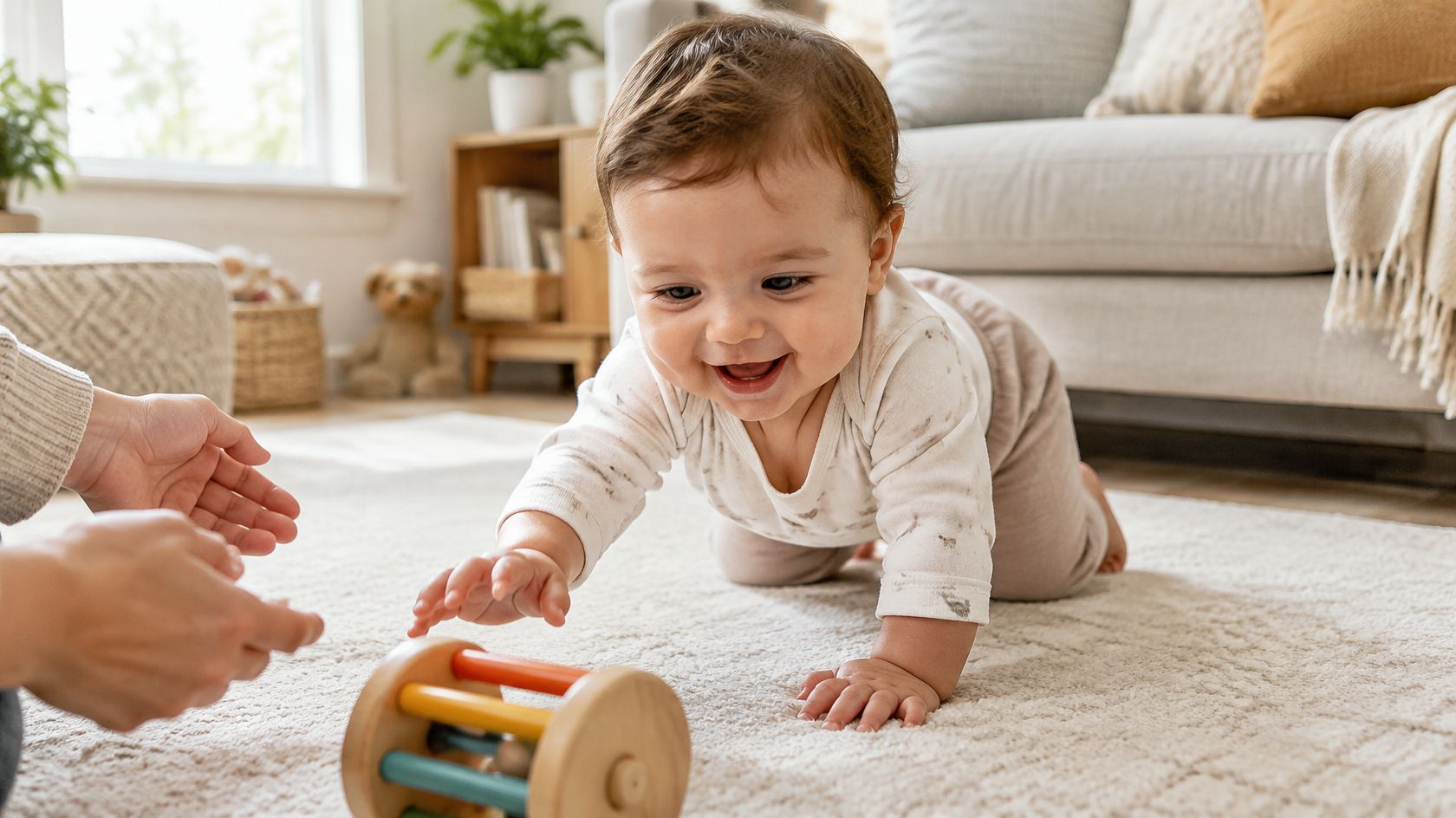
- Classic hands-and-knees crawl: opposite hand and knee move together. Usually appears around 9 to 10 months.
- Belly crawl (commando or army crawl): baby drags their tummy along the floor, pulling with the arms. Often starts around 7 to 8 months.
- Bottom scoot: baby sits and pushes forward with one or both legs.
- Bear crawl: on hands and feet with straight arms and legs, often just before walking.
- Crab crawl: moving sideways or backward, pushing with the hands.
- Rolling: some babies simply roll from one side of the room to the other.
All of these count as independent movement. Many babies switch styles as they get stronger. If your baby is crawling backwards, that’s very common at first: their arms are often stronger than their legs, so they push themselves back. It usually sorts itself out within a few weeks.
Do Babies Need to Crawl?
Not necessarily. A few children never crawl, and if your baby uses each arm and leg equally and coordinates both sides of the body, there’s no cause for concern, according to the AAP. In fact, when the CDC and AAP updated their milestone checklists in 2022, crawling was removed as a milestone, partly because babies vary so much in whether and how they crawl, as reported by The Philadelphia Inquirer.
That said, crawling has real benefits. It builds strength in the arms, shoulders, core and hips, helps both sides of the body work together, and lets babies explore and solve problems on their own. So it’s worth encouraging, even if it isn’t a must.
Signs Your Baby Will Crawl Soon
- Pushing up on straight arms during tummy time
- Getting onto hands and knees and rocking back and forth
- Pivoting in circles on their tummy
- Moving from lying down to sitting (and back) on their own
- Scooting backward or reaching hard for toys just out of reach
- Getting frustrated when they can’t get to something they want
How to Help Your Baby Crawl
- Do daily tummy time. Supervised tummy time builds the neck, shoulder and arm strength babies need. Cleveland Clinic suggests aiming for about 10 minutes per month of age each day, split into several short sessions, on a firm, flat surface, never on a sofa or bed.
- Put toys just out of reach. A favorite toy, a rolling ball or a mirror a little in front of your baby gives them a reason to move.
- Get down on the floor. Lie a short distance away and call your baby. You are their favorite motivator.
- Give lots of free floor time. Limit time in car seats outside the car, swings, bouncers and carriers when your baby is awake and happy, so they have room to practice.
- Help them find hands and knees. Gently place your baby on hands and knees, or put a rolled towel under their chest for support, so they get used to the position.
- Let them go barefoot. Bare feet grip the floor better than socks on smooth surfaces.
- Make a mini obstacle course. Cushions, tunnels and low pillows to crawl over (always supervised) build strength and confidence.
Skip the baby walker. The AAP strongly urges parents not to use walkers: they don’t help babies learn to walk, can reduce their desire to walk, and cause falls, including down stairs. Read more in our article on whether baby walkers are safe.
Babyproof Before Your Baby Crawls
Once babies can move, they get into everything fast. Do a crawl-height walkthrough of your home and:
- Anchor furniture and TVs to the wall. Between 2000 and 2018, 93% of child deaths from furniture, TV and appliance tip-overs involved children aged 5 and under, according to the US Consumer Product Safety Commission.
- Install sturdy gates at the top and bottom of stairs.
- Clear the floor of choking hazards like coins, button batteries, balloon pieces and small toy parts.
- Cover outlets and secure cords from blinds, lamps and chargers.
- Lock away cleaning products and medicines in high or locked cabinets.
- Stop using the changing table once your baby can flip over; change them on the floor instead.
Crawling also means your baby will soon pull up to stand, often in the crib. Lower the crib mattress before that happens. If it’s disrupting sleep, our guide to the 8 month sleep regression explains why and what helps.
When to Talk to Your Pediatrician
Crawling on its own isn’t a red flag, but talk to your pediatrician if your baby:
- Isn’t sitting on their own by 9 months
- Shows little interest in moving or exploring by around 10 months
- Seems very stiff or very floppy
- Uses one side of the body much more than the other, or drags one arm or leg
- Doesn’t bear any weight on their legs when held standing
- Isn’t pulling up to stand by about 12 months
- Loses a skill they used to have
If you’re worried, don’t wait. Early support from a pediatric physical therapist is easy to arrange and works best when started early. Our guide to gross and fine motor development from 0 to 12 months shows how crawling fits with your baby’s other physical skills, and what comes next in 10 to 12 month development.
Frequently Asked Questions About Crawling
When do babies start crawling?
Most babies crawl between 7 and 10 months. Some start around 6 months and others closer to 11 months, and both are normal.
Is it normal for a baby not to crawl at 9 months?
Yes, many babies aren’t crawling yet at 9 months. Talk to your pediatrician if your baby isn’t sitting on their own by 9 months or shows little interest in moving.
Can babies skip crawling?
Yes. A few babies never crawl and go straight to scooting, cruising or walking. That’s usually fine if they use both sides of the body equally.
Why is my baby crawling backwards?
It’s very common early on. Babies’ arms are often stronger than their legs, so they push themselves backward. Most crawl forward within a few weeks.
What is the army crawl?
The army or commando crawl is when a baby drags their tummy along the floor and pulls with their arms. It often comes before crawling on hands and knees.
How can I help my baby crawl?
Give daily supervised tummy time, lots of floor play, and toys just out of reach. Limit time in seats and swings, and skip baby walkers.
The Bottom Line
Most babies crawl between 7 and 10 months, but anywhere from about 6 to 11 months is normal, and some babies skip crawling entirely. What matters more than the exact age is that your baby is moving, exploring and using both sides of the body. Give plenty of tummy time and floor play, babyproof early, skip the walker, and check in with your pediatrician if your baby isn’t sitting by 9 months, seems stiff or floppy, or favors one side.
This article is for general information and isn’t a substitute for medical advice. Always contact your pediatrician with questions about your baby’s development.