












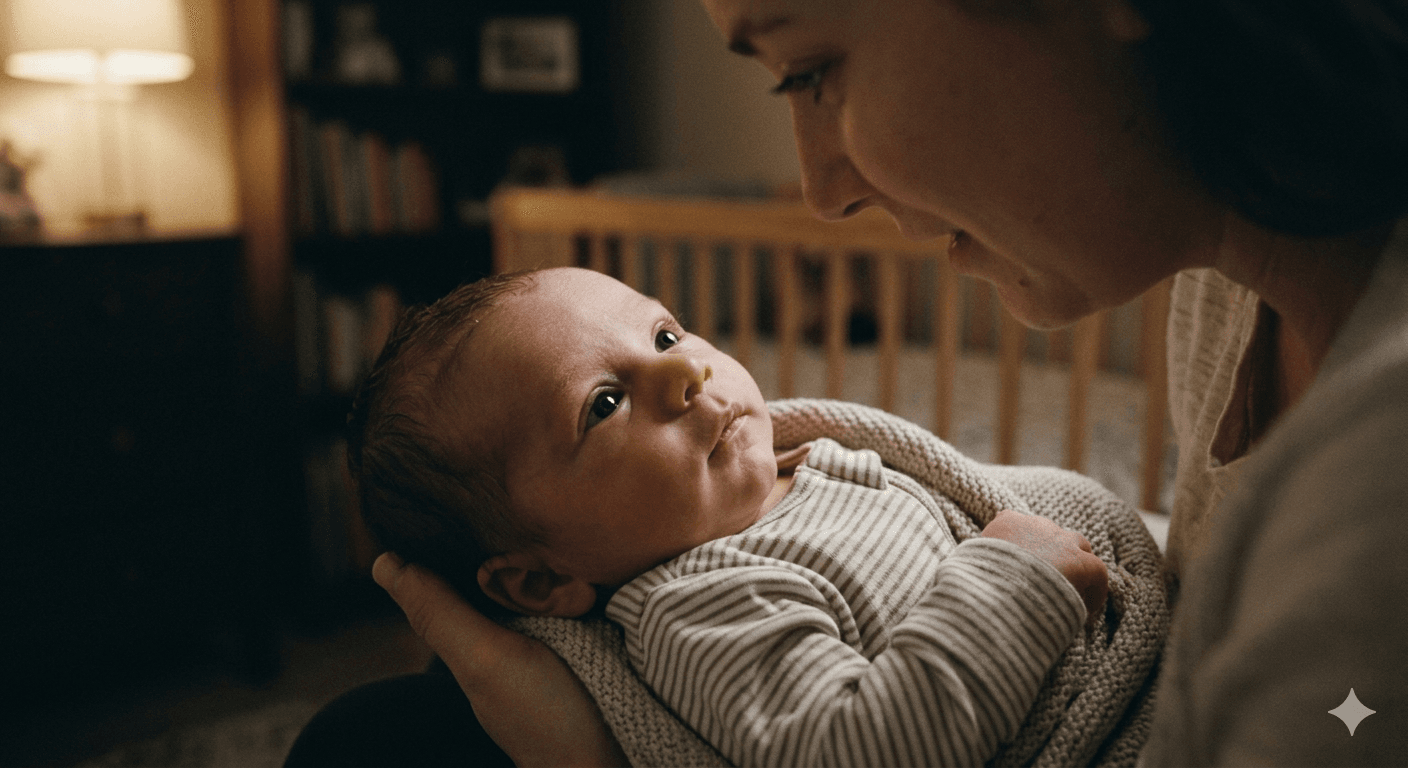
You are gazing down at your newborn and they seem to be gazing right back at you. But what do they actually see?
The answer is both fascinating and surprisingly practical – and quite different from what most new parents expect.
Newborn vision is limited but purposeful. It is perfectly designed for what matters most in those first days. Here is what is happening behind those brand-new eyes.
How Developed Is a Newborn’s Vision at Birth?
Newborns can see from birth – but their vision is significantly blurry, limited in range, and still developing rapidly.
The eyes themselves are fully formed, but the brain’s visual processing centres are just beginning to come online. It takes months of visual experience for the brain to learn how to interpret the information the eyes are sending.
According to the American Academy of Ophthalmology, newborns have a visual acuity of approximately 20/400.
What someone with normal vision sees clearly at 400 feet, a newborn needs to be at 20 feet to see with similar clarity. Everything beyond their focal range is a blur.
What Can a Newborn See in the First Week?
Range: 8 to 12 Inches
The sweet spot of newborn vision is 8 to 12 inches – which is, not coincidentally, the approximate distance between a feeding baby’s face and their caregiver’s face.
Nature calibrated this perfectly. Within this range, your newborn can make out edges, shapes, and movement.
Beyond it, the world becomes progressively blurrier until it fades to near-indistinguishable forms.
Contrast Over Everything
In the first weeks, what newborns see is far more about contrast than color. Their visual system detects edges and boundaries between light and dark before it can distinguish between hues.
This is why high-contrast patterns – black and white, bold lines, strong geometric shapes – are the most visually stimulating things you can offer a newborn.
Soft pastel colors register far less clearly than sharp contrasts.
Faces First
Human faces are the most compelling thing in a newborn’s visual world.
Babies are drawn to faces instinctively, particularly the high-contrast boundary of the hairline against the forehead and the eyes.
Your face, held about 10 inches from theirs, is literally the most interesting thing they can see. This face preference is not just preference – it is the beginning of social and emotional bonding.
Light and Slow Movement
Newborns notice changes in light – they will turn toward a bright window or lamp.
They also have a rudimentary ability to track slow-moving objects, though this develops far more noticeably in weeks 2 to 4.
A gently moving mobile within their focal range will capture their attention briefly, but do not expect sustained tracking yet.
For more on what your newborn is experiencing in the first weeks, see our 1 to 2 month baby development guide.
What Colors Can Newborns See?
Color vision in newborns is very limited. The cone cells in the retina – responsible for detecting color – are present but immature.
Here is how color perception develops in the first months:
- Weeks 1 to 4: High contrast black, white, and dark grey are most visible. Color is barely perceptible.
- Months 2 to 3: Red tends to be the first color perceived with some clarity, as red-sensitive cones develop first
- Months 3 to 5: Color perception expands and improves significantly – babies begin distinguishing between more hues
- By 5 months: Color vision is approaching adult-level capability
The American Optometric Association has detailed information on how infant vision develops month by month through the first year.
What Is Your Newborn Looking At Right Now?
In the first week, your newborn will be most drawn to:
- Your face – especially up close, at 8 to 12 inches
- High-contrast edges and bold patterns
- Light sources like windows or lamps
- The boundary where the wall meets the ceiling – a long, high-contrast line they can actually see
That last one surprises many parents.
If your newborn seems to be staring at a blank corner of the room, they are likely not zoning out – they are tracking the high-contrast edge of the ceiling line.
Their visual system is drawn to it because it is one of the clearest things in their field of vision.
How to Support Your Newborn’s Visual Development
Get Face to Face
The single most important thing you can do is be close and present. Hold your newborn so your face is about 10 inches from theirs.
Talk to them, make expressions, let them study you.
They are absorbing far more than their sleepy, unfocused gaze might suggest.
This face-to-face time is both developmental input and the earliest form of social bonding.
Use High-Contrast Materials
Black and white picture books, high-contrast cards with simple bold patterns, and geometric shapes give your newborn’s developing visual system something meaningful to work with.
Keep sessions short – 2 to 3 minutes is plenty before the visual system fatigues. These can be introduced from the first days home.
Provide Gentle Environmental Variety
Carry your baby through different rooms. Take them to a window.
A brief outdoor walk on a calm day offers rich, varied visual input – dappled light through leaves, the contrast of sky against buildings, the movement of trees.
Even blurry versions of these scenes are stimulating and novel.
Avoid Visual Overwhelm
Bright, busy, rapidly flashing environments are overwhelming for a newborn whose visual processing system is still primitive.
Keep stimulation gentle and watch for cues that your baby has had enough – looking away, fussing, closing their eyes, or becoming glassy-eyed are all ‘I need a break’ signals worth respecting.
For more newborn care tips and daily routines, visit our newborn daily care section.
When Should a Newborn Have an Eye Exam?
Most hospitals perform a basic eye screening shortly after birth. The American Academy of Pediatrics recommends vision screening at every well-child visit through the first year.
Talk to your paediatrician if your baby’s eyes cross consistently after 3 months, if they do not seem to track a slow-moving object by 2 to 3 months, or if one eye appears to wander or turn.
Frequently Asked Questions
Can my newborn recognise my face in the first week?
They can perceive faces and show a preference for them, but true recognition – the ability to identify your specific face as a familiar person – develops over the following weeks as memory and visual acuity both mature. By around 2 to 3 months, most babies show clear recognition of familiar caregivers.
Should I worry if my newborn’s eyes cross occasionally?
Occasional crossing in the first 2 to 3 months is normal as the eye muscles are still developing coordination. Persistent or constant crossing after 3 months should be evaluated by a paediatric eye specialist.
Do newborns prefer looking at certain colours?
In the first weeks, they do not so much prefer colours as they respond to contrast. A black and white pattern will hold their attention longer than a pale pink one, not because of the colour but because of the contrast it provides.
The Bottom Line
Your newborn’s vision is limited – but it is perfectly calibrated for what matters most right now: you.
Get close, make eye contact, talk to them, and let them study your face. Those blurry, wondering eyes are taking in more than you think.
For more on newborn development week by week, browse our 1 to 2 month development guides.
Sources:
American Academy of Ophthalmology — Baby Vision Development