

Last reviewed: November 6, 2026 · Based on guidance from the American Academy of Pediatrics, Seattle Children's Hospital, MedlinePlus and the FDA.
Quick answer: For babies, a fever is a temperature of 100.4°F (38°C) or higher taken rectally, according to the American Academy of Pediatrics (AAP). If your baby is under 3 months old and has a rectal temperature of 100.4°F or higher, call your pediatrician right away, even if they seem fine. If you can’t reach them, go to the emergency room. For older babies, how your baby looks and acts matters more than the number on the thermometer. Go to the ER or call 911 for trouble breathing, a baby who is hard to wake, a seizure or signs of dehydration.
Fever season and cold and flu season go hand in hand. A warm forehead at 2 a.m. can make any parent’s heart race. The good news is that most fevers in babies are caused by common viruses and are a sign that the body is fighting an infection. Here’s exactly what counts as a fever, how to take your baby’s temperature, when to call the doctor, when to go to the ER, and how to keep your baby comfortable.
What Is Considered a Fever for a Baby?
A baby’s average body temperature is about 98.6°F (37°C), but it naturally goes up and down a little during the day. A reading becomes a fever once it reaches a certain point, and that point depends on how you take the temperature. Seattle Children’s Hospital uses these cutoffs:
| How you take it | It’s a fever at | Best for |
|---|---|---|
| Rectal (bottom) | 100.4°F (38°C) or higher | Birth to 4 years. The most accurate method. |
| Forehead (digital temporal artery) | 100.4°F (38°C) or higher | 3 months and up. Forehead strips are not accurate. |
| Ear | 100.4°F (38°C) or higher | 6 months and up. Not accurate under 6 months. |
| Armpit | 99°F (37.2°C) or higher | Screening at any age. The least accurate method. |
| Mouth (oral) | 100°F (37.8°C) or higher | 4 years and up. |
Feeling your baby’s forehead or cheeks with your hand isn’t a reliable way to tell if they have a fever. Use a digital thermometer.
Is 99.1, 99.5 or 99.9 a Fever?
No, not if you took the temperature rectally, by forehead or in the ear. Readings in the 99s are within the normal range for those methods. Under the arm is different. An armpit reading of 99°F or higher may be a fever, so recheck it with a rectal thermometer, especially if your baby is under 3 months old.
How to Take Your Baby’s Temperature
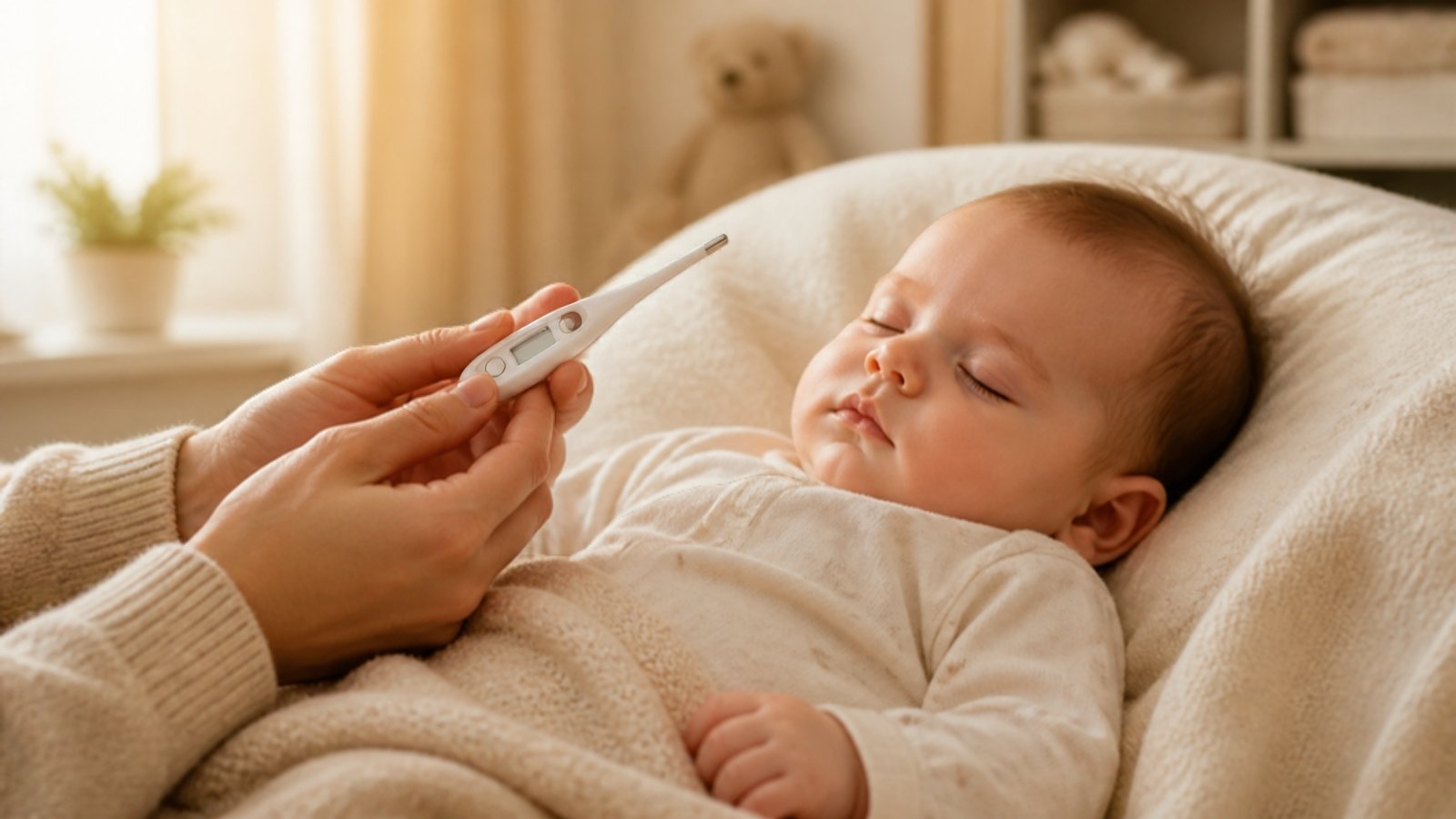
For babies and young children, a rectal temperature with a digital thermometer is the gold standard. It sounds harder than it is. Here’s how Seattle Children’s recommends doing it:
- Lay your baby on their tummy across your lap, or on their back with their legs bent up toward their chest.
- Put a little petroleum jelly on the tip of the thermometer and around your baby’s bottom.
- Gently slide the tip in. For babies under 6 months, go no more than 1/2 inch, just until the silver tip is no longer visible. For older babies, go no more than 1 inch. Stop if you feel resistance.
- Hold your baby still until the thermometer beeps, usually about 10 seconds.
- Clean the thermometer, and label it “rectal only” so it isn’t used in anyone’s mouth.
Tips for an accurate reading: For an armpit reading, make sure the armpit is dry and hold your baby’s elbow against their chest until the beep. If your baby has just come in from the cold, wait about 15 minutes before taking an ear temperature. Don’t take a rectal temperature if your baby has a weak immune system or a condition like leukemia, unless your doctor says it’s OK.
When to Call the Doctor for a Baby’s Fever
How old your baby is makes a big difference. The AAP gives these guidelines:
| Baby’s age | Call your pediatrician if |
|---|---|
| Under 3 months | Rectal temperature is 100.4°F (38°C) or higher. Call right away, even if there are no other symptoms. |
| 3 to 6 months | Temperature is 101°F (38.3°C) or higher. |
| 6 months and older | Temperature is 103°F (39.4°C) or higher. |
| Under 2 years | A fever of any level lasts more than 24 hours. |
| Any age | The temperature rises above 104°F (40°C) again and again. |
Why Babies Under 3 Months Need Urgent Care
Young babies have immature immune systems. A fever can be the only sign of a serious infection, such as a urinary tract, blood or brain infection. That’s why a fever of 100.4°F or higher in a baby under 3 months always needs a doctor right away, day or night. Don’t give fever medicine before you talk to the doctor.
Also Call Your Pediatrician If Your Baby Has a Fever and
- Looks very ill, is unusually drowsy or is very fussy
- Still acts sick after the fever comes down
- Seems to be getting worse
- Has severe ear pain, a severe sore throat, repeated vomiting or diarrhea, or an unexplained rash
- Has a health condition that affects the immune system or heart, such as sickle cell disease, cancer or a heart problem
- Has had a seizure
When to Take a Baby to the ER for a Fever
Go to the emergency room or call 911 if your baby has a fever and any of these signs:
- Trouble breathing, such as fast breathing, grunting, flaring nostrils or the skin pulling in between the ribs
- Blue or gray lips, tongue or skin
- Very hard to wake, floppy or not responding to you
- Crying that won’t stop no matter what you do, or seeming confused
- A stiff neck
- A rash that doesn’t fade when you press a clear glass against it, which the NHS lists as an emergency sign
- A seizure that lasts longer than 5 minutes
- Signs of dehydration, such as no wet diapers in 8 hours, a dry mouth, no tears or a sunken soft spot
- Was in a very hot place, like an overheated car. This can be heatstroke and is an emergency.
- Is under 3 months old with a fever of 100.4°F or higher and you can’t reach your pediatrician
Trust your instincts. If your baby seems very sick to you, get help, whatever the thermometer says.
How to Bring Down a Baby’s Fever Safely
A fever itself is usually not harmful. It’s the body’s natural response to infection. The goal of treatment is to help your baby feel more comfortable, not to reach a perfect number. If your baby is over 3 months, is still feeding and playing, and seems fairly comfortable, you may not need medicine at all.
Keep Them Cool and Comfortable
- Dress your baby in one light layer, such as a cotton onesie, and use only light covering. Don’t bundle them up, even if they have chills. See our guide on how to dress a baby with a fever at night.
- Keep the room comfortably cool.
- Skip cold baths, ice and rubbing alcohol. MedlinePlus warns these can cause shivering and make things worse.
- Let your baby rest. Quiet cuddles and naps are fine. For sleep, always place your baby on their back in their own crib or bassinet, on a firm, flat surface with nothing else in it, even when they’re sick.
Offer Plenty of Fluids
Fever makes babies lose fluid faster. Keep offering breast milk or formula, often in smaller, more frequent feeds. Babies under 6 months should not be given water. Don’t give juice. If your baby is vomiting or has diarrhea, ask your pediatrician whether an oral electrolyte solution is right for them. Our guide to stomach bugs and dehydration in babies has more on spotting dehydration.
Fever Medicine: Tylenol and Motrin for Babies
- Under 3 months: don’t give any fever medicine until you’ve talked to your baby’s doctor.
- Acetaminophen (Tylenol): can be used for babies 3 months and older. It can be given every 4 to 6 hours if needed. The FDA advises asking your doctor for the right dose for children under 2.
- Ibuprofen (Motrin, Advil): the AAP says not to use it in babies under 6 months unless your doctor tells you to. After 6 months, it can be given every 6 to 8 hours if needed.
- Dose by weight, not age, whenever you can, and check the concentration on the label. Infant liquid acetaminophen is 160 mg per 5 mL.
- Use only the syringe or cup that comes with the medicine. Never use a kitchen spoon.
- Don’t switch back and forth between acetaminophen and ibuprofen unless your doctor tells you to.
- Never give aspirin to a baby or child unless a doctor says it’s OK.
- Skip combination products. Cough and cold medicines are not safe for babies and young children.
Common Causes of Fever in Babies
Most fevers in babies come from viral infections, like colds, the flu, RSV and stomach bugs. Ear infections, urinary tract infections and pneumonia can also cause fever. Some babies run a mild fever after their vaccines. Overheating from too many layers or a hot room can raise a baby’s temperature too.
Does Teething Cause a Fever?
No. Research shows teething can raise a baby’s temperature slightly, but it stays in the normal range. According to the AAP and Cleveland Clinic, teething doesn’t cause a true fever. If your teething baby has a temperature of 100.4°F or higher, look for another cause and call your pediatrician if you’re unsure.
Febrile Seizures: What to Know
A febrile seizure is a seizure caused by a fever. According to the AAP, they happen in about 3 or 4 out of every 100 children between 6 months and 5 years old, most often around 12 to 18 months. They’re frightening to watch, but most last only a minute or two and don’t cause brain damage or lasting harm.
If your baby has a seizure:
- Place them on the floor or a bed, away from hard or sharp objects.
- Turn their head to the side so saliva or vomit can drain.
- Don’t put anything in their mouth.
- Call 911 if the seizure lasts longer than 5 minutes or your baby has trouble breathing. Call your pediatrician after any first seizure.
When to Call the Doctor: Quick Checklist
- Your baby is under 3 months with a rectal temperature of 100.4°F (38°C) or higher
- Your baby is 3 to 6 months with a temperature of 101°F (38.3°C) or higher
- Your baby is over 6 months with a temperature of 103°F (39.4°C) or higher
- The fever lasts more than 24 hours in a child under 2
- The fever keeps rising above 104°F (40°C)
- Your baby seems very ill, very sleepy, very fussy or is getting worse
- Your baby has any emergency sign listed above: call 911 or go to the ER
If your little one is also stuffy, our guide to why newborns sound congested explains how to clear a baby’s nose safely.
Frequently Asked Questions About Fever in Babies
What is considered a fever for a baby?
A fever in a baby is a temperature of 100.4°F (38°C) or higher taken rectally, by forehead or in the ear. Under the arm, 99°F (37.2°C) or higher may be a fever and should be checked again rectally. A baby’s normal temperature is around 98.6°F (37°C) and can vary a little through the day.
Is 99.1 a fever for a baby?
No. A rectal, forehead or ear reading of 99.1°F is within the normal range and isn’t a fever. If you took it under the arm, 99°F or higher may be a fever, so recheck with a rectal thermometer, especially if your baby is under 3 months old.
When should I take my baby to the doctor for a fever?
Call your pediatrician right away if your baby is under 3 months and has a rectal temperature of 100.4°F (38°C) or higher. Call if your baby is 3 to 6 months with 101°F (38.3°C) or higher, or over 6 months with 103°F (39.4°C) or higher. Also call if a fever lasts more than 24 hours in a child under 2, or if your baby seems very ill, very sleepy or very fussy.
When should I take my baby to the ER for a fever?
Go to the ER or call 911 if your baby has a fever with trouble breathing, blue lips, a stiff neck, a rash that doesn’t fade when pressed, is very hard to wake, or won’t stop crying. Also go for a seizure lasting more than 5 minutes, signs of dehydration such as no wet diaper in 8 hours, or a fever of 100.4°F or higher in a baby under 3 months when you can’t reach your doctor.
Can a baby get a 103 fever from teething?
No. According to the AAP and Cleveland Clinic, teething can raise a baby’s temperature slightly, but it doesn’t cause a true fever of 100.4°F or higher. A 103°F fever means something else, usually an infection, is going on. Call your pediatrician to find the cause.
When can I give my baby Tylenol for a fever?
Don’t give a baby under 3 months any fever medicine until you’ve spoken with their doctor. From 3 months, acetaminophen (Tylenol) can be used to make your baby more comfortable, every 4 to 6 hours if needed, but ask your pediatrician for the right dose for children under 2. Always dose by weight, use the syringe that comes with the medicine, and never give ibuprofen under 6 months unless your doctor says so.
The Bottom Line
A fever in a baby is a rectal temperature of 100.4°F (38°C) or higher. If your baby is under 3 months, any fever means calling your pediatrician right away, day or night. For older babies, watch how they look and act. Call the doctor for 101°F or higher at 3 to 6 months, 103°F or higher after 6 months, or a fever lasting more than 24 hours in a child under 2. Go to the ER for trouble breathing, a baby who is hard to wake, a long seizure or signs of dehydration. At home, keep your baby lightly dressed, offer plenty of breast milk or formula, and use fever medicine only at the right age and dose.
This article is for general information and isn’t a substitute for medical advice. Always contact your pediatrician with questions about your baby’s health.
9 Sources
Newborn Stages uses trusted sources, including government health agencies, children’s hospitals and pediatric organizations, to support the facts in our articles. Read our editorial policy to learn how we research, fact-check and keep our content accurate.
- HealthyChildren.org, American Academy of Pediatrics. Fever and Your Baby.
- HealthyChildren.org, American Academy of Pediatrics. Fever: When to Call the Pediatrician.
- HealthyChildren.org, American Academy of Pediatrics. Ibuprofen Dosing Table for Fever and Pain.
- HealthyChildren.org, American Academy of Pediatrics. Febrile Seizures in Children.
- Seattle Children’s Hospital. Fever: How to Take the Temperature.
- MedlinePlus, U.S. National Library of Medicine. When your baby or infant has a fever.
- U.S. Food and Drug Administration. FDA Drug Safety Communication: Addition of another concentration of liquid acetaminophen marketed for infants.
- NHS. High temperature (fever) in children.
- Cleveland Clinic. Does Teething Cause Fever? Signs and Symptoms.