

Last reviewed: November 9, 2026 · Based on guidance from the American Academy of Pediatrics, the National Highway Traffic Safety Administration, Children's Wisconsin and Cleveland Clinic.
Quick answer: Babies and toddlers should not wear puffy winter coats or snowsuits under car seat straps. In a crash, the padding flattens and leaves the harness too loose, so your child can slip through the straps. Instead, dress your baby in thin, warm layers like fleece, buckle the harness snug enough that you can’t pinch any slack at the shoulder, and then put a blanket or their coat (worn backward) over the buckled straps.
Cold mornings make it tempting to zip your baby into a big snowsuit and head straight to the car. It feels safer and warmer. But the American Academy of Pediatrics (AAP) warns that bulky clothing and car seats are a risky mix. The good news is that keeping your baby both warm and safe only takes a few small changes.
Here’s why puffy coats are a problem, a simple test to check any coat at home, how to do the pinch test, and easy ways to keep your baby cozy on winter drives.
Why Puffy Coats and Car Seats Don’t Mix
A car seat harness only works when it fits snugly against your child’s body. Puffy coats, snowsuits and thick sweaters are full of air and fluffy padding. When you buckle your baby in, the straps feel tight, but they are really tight against the coat, not your baby.
In a crash, the AAP explains that the fluffy padding immediately flattens from the force. That leaves extra space under the harness, and a child can slip through the straps. Children’s Wisconsin notes that a puffy coat can add up to four inches of slack to car seat harness straps. That much slack can be the difference between a harness that holds your child and one that doesn’t.
The AAP adds that the same is true for adults: seat belts also need to fit snugly, without a puffy coat underneath.
The Coat Test: Is Your Baby’s Coat Too Thick?
Not sure if a jacket is thin enough? Try this quick test at home, recommended by Children’s Wisconsin:
- Put the coat on your child.
- Sit them in the car seat, then buckle and tighten the harness.
- Without loosening the harness, unbuckle it and take your child out.
- Take the coat off.
- Put your child back in the seat and buckle the harness without adjusting the straps.
If the harness is now loose, the coat is too thick to wear under the straps. Save it for the walk to and from the car, and take it off before you buckle up.
How to Check the Harness: The Pinch Test
Whatever your baby is wearing, check the harness fit every time. The National Highway Traffic Safety Administration (NHTSA) and the AAP describe three quick checks:
- Strap height: For a rear-facing seat, the shoulder straps should come out at or below your child’s shoulders. For a forward-facing seat, they should be at or above the shoulders.
- Chest clip: Place the chest clip at the center of the chest, even with your child’s armpits.
- Pinch test: After tightening, try to pinch the harness strap vertically at your child’s shoulder with your thumb and forefinger. Your fingers should slide right off. If you can pinch any extra webbing, tighten the straps more.
The AAP points out that thick layers make it harder to get a snug fit, so always do the pinch test after your baby is dressed for the day.
How to Keep Your Baby Warm in the Car Seat
You don’t have to choose between warm and safe. These tips from the AAP and children’s hospitals keep your baby comfortable without getting in the way of the harness:
- Dress in thin layers. Start with a close-fitting base layer, such as long-sleeved bodysuits, leggings or long underwear, then add a warmer top and a thin fleece jacket.
- Add one more layer for babies. As a rule of thumb, the AAP says infants should wear one more layer than adults.
- Don’t forget hats, mittens and socks or booties. They keep your baby warm without touching the straps. If your little one sucks their thumb, try open-finger half-gloves or bring spare mittens, since wet mittens make kids colder.
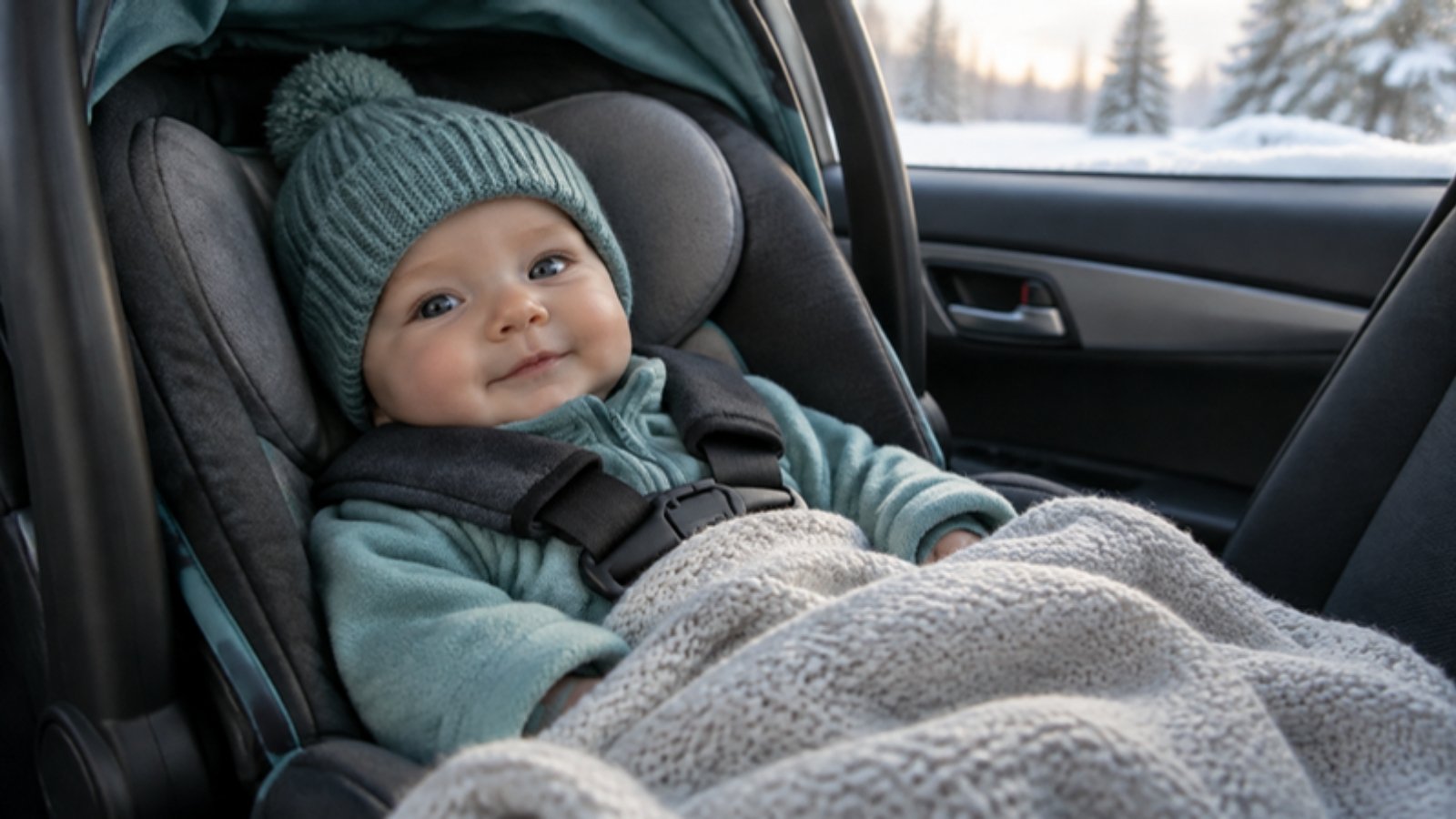
- Put the warmth on top of the harness. After your baby is buckled and the straps pass the pinch test, lay a blanket over them, or put their coat on backward with their arms through the sleeves.
- Bring the infant seat inside. Keeping the infant carrier indoors when you’re not using it means your baby won’t lose body heat sitting in a cold seat.
- Warm up the car if you can. A warmer car means fewer layers are needed. Use a top layer you can remove so your baby doesn’t overheat once the car heats up.
What’s OK Under the Car Seat Harness?
| Clothing | Under the harness? | Better option |
|---|---|---|
| Bodysuit, leggings, long underwear | Yes | Great base layer |
| Thin fleece jacket or fleece footed pajamas | Usually yes | Do the coat test to be sure |
| Hat, mittens, socks or booties | Yes | They don’t touch the straps |
| Puffy coat or down jacket | No | Wear it backward over the buckled harness |
| Snowsuit or pram suit | No | Take it off in the car, use a blanket on top |
| Thick sweater or hoodie | Often no | Do the coat test, or swap for thin fleece |
| Blanket | Never under the baby or straps | Lay it over the buckled harness |
Car Seat Covers, Bunting Bags and Other Add-Ons
Many stores sell cozy car seat inserts, bunting bags and padded covers. Be careful here. The AAP warns that products that didn’t come with your car seat haven’t been crash tested with it, and many winter bundling products are not safe to use in a car seat.
- Avoid anything that goes behind or under your baby or between your baby and the straps, like thick inserts or sleeping-bag style liners. The AAP says never to use sleeping bag inserts or other stroller accessories in a car seat.
- A “shower cap” style cover can be OK. The AAP says a car seat cover is only safe if nothing comes between your baby and the seat or harness. It should stretch over the outside of the seat like a shower cap.
- Keep your baby’s face uncovered. A cover over the face can trap air, and your baby may end up rebreathing it.
- Check with your seat’s maker. The AAP advises not using extra products unless they came with the seat or are specifically approved by the car seat manufacturer.
Does This Apply to Toddlers and Older Kids Too?
Yes. The puffy coat rule applies to every child in a harnessed car seat, not just newborns. Toddlers often protest taking off their coat, so it can help to make it part of the routine: coat off, buckle up, pinch test, then coat on backward like a cozy blanket with sleeves.
For older children in booster seats, Children’s Wisconsin suggests buckling the seat belt first, then putting the coat on backward over their arms and shoulders. The seat belt needs to sit snugly against their body, just like a harness.
A Simple Winter Car Seat Routine
- Dress your baby in thin layers indoors, plus a hat and socks or booties.
- Put on the puffy coat or snowsuit for the walk to the car, or carry your baby in the infant seat (kept indoors) with a blanket over them.
- In the car, take off the bulky coat.
- Buckle the harness, place the chest clip at armpit level and do the pinch test.
- Lay a blanket over the buckled straps or put the coat on backward.
- Once the car warms up, take off the top layer so your baby doesn’t overheat.
Leave a few extra minutes in the morning. Getting a baby ready in winter takes longer, and the AAP also reminds parents to drive slowly and carefully in winter weather.
Don’t Let the Car Seat Become a Bed
Babies often fall asleep on car rides, and that’s fine while you’re driving. But the AAP says car seats and other sitting devices, like swings or reclined bouncy seats, are not safe sleep spaces outside the car. If your baby falls asleep in the car seat, take them out once you arrive and move them to a crib or other safe sleep space to finish the nap. If you can’t do that right away, an adult should keep a close and constant eye on your baby.
When you bring a sleeping baby inside, remove the blanket and extra layers so they don’t get too warm. For safe sleep, your baby should sleep on their back on a firm, flat surface with nothing else in the crib. Our guide on how to dress a baby for sleep in winter explains safe sleep layers and room temperature.
More Winter Car Safety Tips
- Pack a winter emergency kit. The AAP suggests keeping extra blankets, dry clothes, hats, gloves and non-perishable snacks in the car.
- Keep your baby rear-facing as long as possible, until they reach the highest weight or height their seat allows. See when your baby is too big for an infant car seat.
- Never leave your child alone in or around a car, even for a minute, and lock your car when you aren’t using it.
- Planning a holiday trip? Read our tips for a long road trip with an infant and our guide to baby clothes for the first winter.
When to Call the Doctor
Most winter car rides are uneventful. Call 911 right away if your baby is limp, hard to wake, has blue or gray lips, or is struggling to breathe.
Call your pediatrician if your baby:
- Seems unusually cold, pale or sleepy and doesn’t warm up and perk up once indoors
- Seems overheated, sweaty or flushed and doesn’t cool down after you remove layers
- Has a fever, especially if they are under 3 months old (a rectal temperature of 100.4°F or 38°C or higher). See our guide on fever in babies.
- Was in a car crash, even a minor one, and you have any concerns about how they are acting
For help with car seat fit or installation, ask your pediatrician or find a certified child passenger safety technician near you.
Frequently Asked Questions About Winter Coats and Car Seats
Can a baby wear a coat in a car seat?
Not a puffy one. Bulky coats and snowsuits flatten in a crash and leave the harness too loose, so your baby could slip through the straps. Take the coat off before you buckle up, then lay it or a blanket over the snug harness.
How do I know if my baby's coat is too thick for the car seat?
Do the coat test. Buckle and tighten the harness with the coat on, take your child out without loosening the straps, remove the coat and buckle them back in. If the harness is now loose, the coat is too thick to wear under the straps.
Is a thin fleece jacket OK in a car seat?
Usually, yes. The AAP suggests thin layers, such as a close-fitting base layer, a warmer top and a thin fleece jacket. Do the coat test and the pinch test to make sure the harness is still snug.
Can I put a blanket over my baby in the car seat?
Yes, as long as it goes over the buckled harness, never under your baby or between your baby and the straps. Keep the blanket away from your baby’s face, and take it off once the car warms up so your baby doesn’t overheat.
Are car seat covers and bunting bags safe?
Only some are. The AAP says a cover is OK only if nothing comes between your baby and the seat, like a “shower cap” cover that stretches over the outside of the seat, with your baby’s face left uncovered. Inserts, bunting bags and liners that go behind or under your baby didn’t come with the seat and haven’t been crash tested with it.
How tight should car seat straps be in winter?
Snug enough that you can’t pinch any extra webbing at your child’s shoulder with your thumb and forefinger. Place the chest clip at the center of the chest, even with the armpits. Check the fit after your baby is dressed, since even thin winter layers can add some bulk.
The Bottom Line
Puffy coats and snowsuits keep babies warm outside, but they make car seat straps too loose to protect your child in a crash. Dress your baby in thin layers, take off the bulky coat in the car, buckle the harness snugly with the chest clip at armpit level and do the pinch test. Then add warmth on top with a blanket or a backward coat, and skip add-on products that didn’t come with your seat.
This article is for general information and isn’t a substitute for medical advice. Always contact your pediatrician with questions about your baby’s health.
6 Sources
Newborn Stages uses trusted sources, including government health agencies, children’s hospitals and pediatric organizations, to support the facts in our articles. Read our editorial policy to learn how we research, fact-check and keep our content accurate.
- American Academy of Pediatrics. AAP Winter Safety Tips: Puffy Coats Should Not Be Worn in Car Seats.
- HealthyChildren.org (American Academy of Pediatrics). Car Seats: Information for Families.
- HealthyChildren.org (American Academy of Pediatrics). Baby Carriers: Always Use in the Car.
- National Highway Traffic Safety Administration. How to Use a Car Seat Harness.
- Children’s Wisconsin. Puffy Coats and Car Seats.
- Cleveland Clinic. Why Your Child’s Puffy Coat and Car Seat Are a Dangerous Combination.