

Last reviewed: November 13, 2026 · Based on guidance from the U.S. Consumer Product Safety Commission (CPSC), the American Academy of Pediatrics, Nemours KidsHealth, Children's Hospital of Philadelphia and CHOC.
Quick answer: The safest toys for babies and toddlers match the age on the label, are too big to fit in a child’s mouth, and have no loose button batteries, small magnets, long strings or parts that can break off. For children under 3, a toy or part that fits inside an empty toilet paper roll is a choking hazard. Keep deflated balloons away from children under 8, skip water beads, and throw away plastic wrap right after gifts are opened. If you think your child swallowed a button battery or a magnet, go to the emergency room right away. Don’t wait for symptoms.
The holidays bring a pile of new toys into the house, often from relatives who haven’t shopped for a baby in years. Most of those gifts are fine. A few are not, and the risky ones are not always the ones you’d expect. A cute light-up card with a coin battery, a magnetic building set meant for an older cousin, or a stuffed animal with a long ribbon can all cause serious harm to a baby or toddler.
The U.S. Consumer Product Safety Commission (CPSC) estimates that 154,700 children 12 and younger were treated in emergency rooms for toy-related injuries in 2023, and 10 children died in toy-related incidents. Among children under 5, the most common diagnosis was swallowing something. December is also Safe Toys and Gifts Month, a good reminder to check every gift before it reaches little hands.
This guide walks you through what to look for when you buy, the hidden hazards to watch for, and what to do if something goes wrong.
Why babies and toddlers need different toys
Babies and young toddlers explore the world with their mouths. They chew, suck and taste almost everything, and their airways are small. That is why the rules for children under 3 are stricter than for older kids.
The age range on a toy’s label is based on safety, not on how smart your child is. A toy marked 3+ usually has small parts or other features that are dangerous for younger children. Even if your 2 year old seems advanced, follow the label.
If you have older children too, think about the whole house. A toy that is perfect for a 7 year old can be a choking hazard for a crawling baby who finds a piece on the floor.
The toilet paper roll test for choking hazards
Choking is the biggest toy danger for children 3 and younger. Nemours KidsHealth advises that toys for this age be at least 1¼ inches (3 cm) in diameter and 2¼ inches (6 cm) long.
You don’t need a ruler. Use an empty toilet paper roll tube:
- Drop the toy, or any part that could come off it, into the tube.
- If it fits inside, it is too small for a child under 3.
- Check parts that could break or pull off too, like eyes on stuffed animals, wheels on cars and caps on markers.
Also avoid marbles, coins and balls that are 1.75 inches (4.4 cm) across or smaller for young children, because they can block the throat. The CPSC lists choking on small balls and crayons among the leading causes of toy-related deaths.
Food is a choking risk too during the holidays. Our guide to Thanksgiving foods for babies covers which party foods to keep away from little ones.
Hidden toy hazards to watch for
Button and coin batteries
Small round batteries are in many toys, remote controls, musical greeting cards, flameless candles and holiday decorations. If a child swallows one, it can burn through the throat or food pipe. Children’s Hospital of Philadelphia warns that severe injuries often happen in under two hours, and children often swallow batteries without anyone seeing.
- Choose toys with battery compartments that close with a screw.
- Check gifts, cards and decorations for loose or easy-to-open battery covers.
- Store spare and used batteries locked away, and recycle old ones promptly.
Early signs can look like a cold or stomach bug: coughing, gagging, vomiting, chest pain or trouble swallowing. That is why you should act on suspicion alone (see “What to do in an emergency” below).
Small, strong magnets
High-powered magnets are found in some building sets, desk toys and magnetic ball kits made for teens and adults. If a child swallows more than one, or a magnet plus a metal object, they can pull together through the walls of the intestines. The CPSC says this can cause holes, twisting or blockage of the bowel, infection and even death.
Keep magnet sets out of homes with young children, and check magnetic toys often for loose or missing pieces.
Water beads
Water beads are tiny gel balls that grow when soaked. If swallowed, they can block a child’s throat or intestines. The CPSC estimates about 6,300 water bead ingestion injuries were treated in U.S. emergency rooms from 2017 to 2022, and a 10-month-old baby died in 2023 after swallowing them. A federal standard approved in 2025 limits how large water bead toys can expand, but some water bead products not sold as children’s toys are not covered. The simplest choice is to keep them out of homes with babies and toddlers.
Strings, cords and ribbons
Long strings can wrap around a baby’s neck. KidsHealth advises avoiding strings longer than 7 inches (18 cm) on toys for babies and toddlers. Remove gift ribbons and tags from stuffed toys before handing them over.
Balloons and packaging
Deflated or broken balloons are a serious choking hazard. The CPSC says to keep them away from children under 8. Plastic wrap and other packaging are hazards too, so gather and throw them away right after gifts are opened.
Loud toys and toys that shoot
Some rattles, squeakers and electronic toys can be as loud as a car horn, especially when held close to the ear. The American Academy of Pediatrics (AAP) recommends avoiding loud toys to protect hearing, and avoiding toys that shoot objects into the air, which can cause eye injuries.
A safe toy checklist by age
| Age | Good choices | Skip |
|---|---|---|
| 0 to 6 months | Large soft rattles, washable cloth books, board books, sturdy teethers | Anything with small parts, long strings, bean-pellet stuffing or loud sounds |
| 6 to 12 months | Stacking cups, large blocks, push-button toys with screwed battery covers, board books | Small balls, toys with detachable parts, button batteries, magnets |
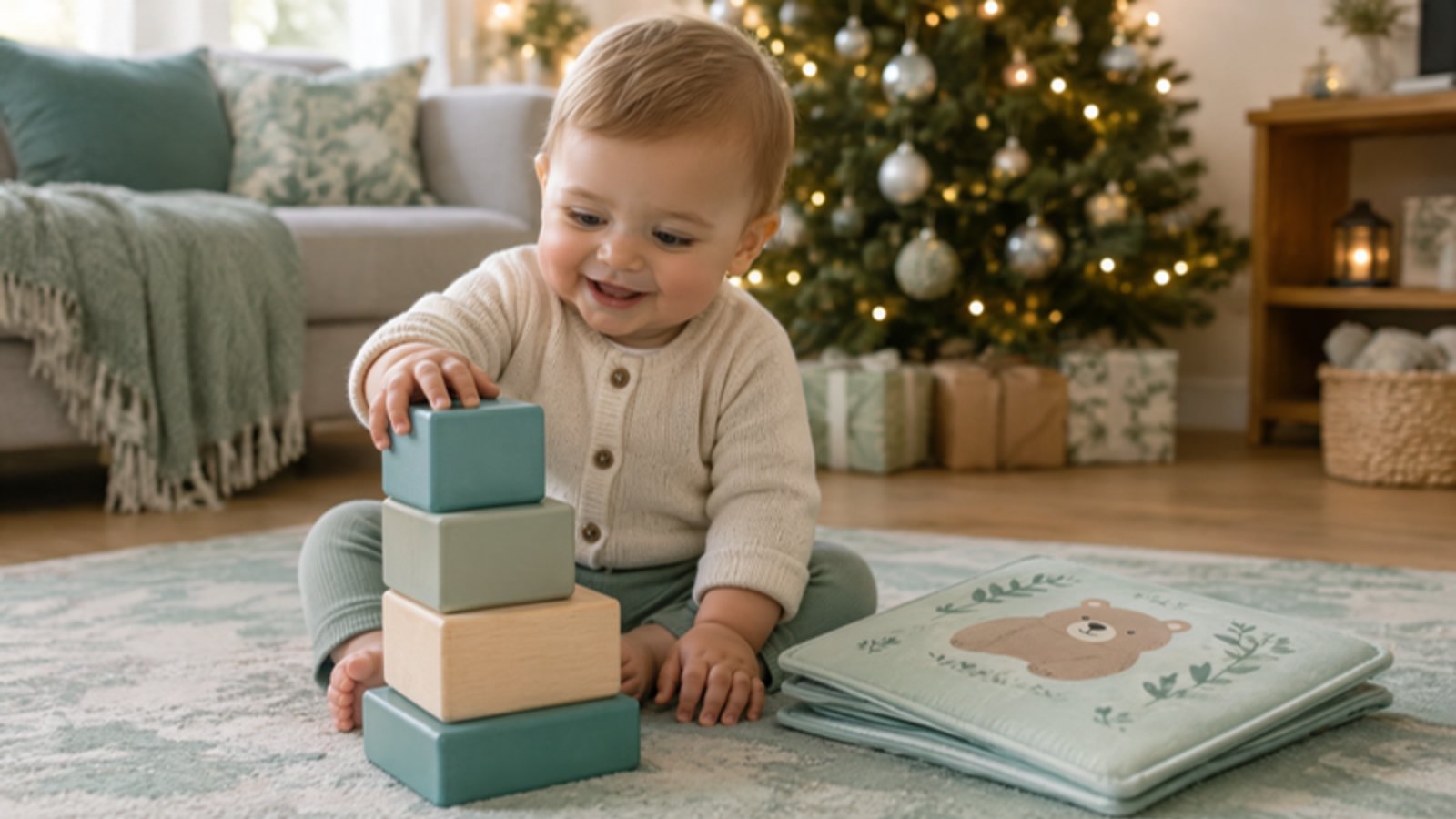
| 1 to 3 years | Chunky puzzles, large building blocks, push and pull toys, crayons labeled ASTM D-4236, ride-on toys with a harness or strap | Toys labeled 3+, marbles, deflated balloons, water beads, magnet sets |
For more play ideas, see our list of the best toys for newborn brain development.
How to choose a safe toy: 10 quick checks
- Read the age label and follow it, even for advanced little ones.
- Do the toilet paper roll test on the toy and any part that could come off.
- Look for sturdy construction. The AAP suggests sturdy plastic, since thin plastic can break into sharp pieces.
- Check stuffed toys for secure seams, secure parts and washable fabric. Avoid ones filled with small bean-like pellets.
- Check battery covers and choose toys where the compartment is held shut with a screw.
- Look for “nontoxic” on toys and art supplies, and ASTM D-4236 on crayons and paints.
- Be careful with hand-me-downs. Older toys may not meet current standards, and painted toys made before 1978 may contain lead.
- Buy from sellers you know. When shopping online, the CPSC suggests checking the product page for a choking hazard warning on toys with small parts, balls, marbles or balloons.
- Add safety gear. Give a helmet with any scooter or riding toy for older kids, and make sure it is worn every time. Non-motorized scooters caused the most toy-related injuries in 2023, about 53,000 across all ages.
- Check for recalls at CPSC.gov before buying secondhand or when you get a gift without its box.
Toys and safe sleep
A crib is for sleeping, not for toys. The AAP advises keeping soft objects, loose bedding and anything that could cause suffocation or strangulation out of the crib. Hanging crib toys like mobiles and crib gyms should be out of reach, and you should remove them when your baby starts to push up on hands and knees or at 5 months, whichever comes first.
A new plush toy can stay in the play area for supervised cuddles. Put it away when your baby goes down for a nap or for the night.
Holiday visits and travel
Grandparents’ homes and holiday parties often have hazards you won’t find at home: magnet sets, loose batteries, small decorations and older cousins’ toys. A quick sweep of the floor at baby height before your little one starts crawling around helps a lot. If someone else is watching your baby, a simple baby handover sheet can include a note about which toys are off limits.
If you are traveling, pack a few familiar, age-appropriate toys so your baby isn’t handed whatever is nearby. Our guide to flying with a baby has more tips for holiday trips.
What to do in an emergency
If you think your child swallowed a button battery
- Go to the nearest emergency room right away, or call 911. Don’t wait for symptoms.
- Call Poison Control at 1-800-222-1222 on the way if you can.
- Don’t make your child vomit, and don’t give food or drink, except honey as described below.
- For children older than 1 year only, CHOC and CHOP say you can give 2 teaspoons of honey every 10 minutes, up to six doses, on the way to the hospital if it is close at hand. Never give honey to a baby under 1, and never delay the trip to give it.
If you think your child swallowed a magnet or water beads
Get medical care right away. With magnets, the CPSC warns that serious internal injury can happen before any symptoms appear, so don’t wait to see if your child seems fine.
If your child is choking
If your child can’t cry, cough, breathe or talk, call 911 and start choking first aid for their age. Taking an infant and child CPR class before the holidays is one of the best gifts you can give your family.
When to call the doctor
Call 911 or go to the emergency room if your child:
- May have swallowed a button battery, magnet or water beads
- Is choking, gagging or can’t swallow
- Has trouble breathing or a cough that started suddenly while playing
- Is vomiting, especially with blood, or has belly or chest pain after possibly swallowing something
Call your pediatrician if your child has a toy injury you’re unsure about, such as an eye injury, a deep cut or a bump that is not getting better, or if you think a small object went into the ear or nose.
Frequently Asked Questions About Safe Toys for Babies and Toddlers
What are the safest toys for babies?
Choose toys labeled for your child’s age that are too big to fit inside an empty toilet paper roll. Look for sturdy, washable toys with no small parts, long strings, loose batteries or loud sounds. Soft rattles, cloth books, stacking cups and large blocks are good choices.
How do I know if a toy is a choking hazard?
Drop the toy, and any part that could come off, into an empty toilet paper roll tube. If it fits inside, it is a choking hazard for children under 3. KidsHealth advises toys for this age be at least 1¼ inches wide and 2¼ inches long.
Why are button batteries so dangerous for kids?
A swallowed button battery can burn through the throat or food pipe, and severe injuries often happen in under two hours. Early signs can look like a cold or stomach bug. Choose toys with screw-closed battery covers and go to the ER right away if you suspect your child swallowed one.
Are magnetic toys safe for toddlers?
No. Strong magnets can pull together through the walls of the intestines and cause serious injury or death if more than one is swallowed. Keep magnet sets and toys with small loose magnets out of homes with babies and toddlers.
Can babies sleep with stuffed animals?
It is best to keep them out of the crib. The AAP advises keeping soft objects and stuffed animals out of a baby’s sleep space. Plush toys are fine for supervised play while your baby is awake.
What toys should I avoid for kids under 3?
Water beads, small magnet sets, toys labeled 3+, deflated balloons, marbles and small balls are best avoided for children under 3. Also skip toys with long strings, bean-pellet stuffing or toys that shoot objects. Check secondhand toys for recalls at CPSC.gov.
The Bottom Line
Safe toys for babies and toddlers are big, sturdy and right for their age. Use the toilet paper roll test, check battery covers, and keep magnet sets, water beads and deflated balloons out of reach. Toss packaging right after gifts are opened, keep toys out of the crib, and act fast if you think your child swallowed a battery or magnet. A few minutes of checking can keep the holidays happy and safe.
This article is for general information and isn’t a substitute for medical advice. Always contact your pediatrician with questions about your baby’s health.
8 Sources
Newborn Stages uses trusted sources, including government health agencies, children’s hospitals and pediatric organizations, to support the facts in our articles. Read our editorial policy to learn how we research, fact-check and keep our content accurate.
- U.S. Consumer Product Safety Commission. Happy Holidays Start with Safety: CPSC Urges Families to Cook, Decorate and Select Toys with Care This Season.
- American Academy of Pediatrics, HealthyChildren.org. How To Buy Safe Toys.
- Nemours KidsHealth. Choosing Safe Toys for Toddlers and Preschoolers.
- Children’s Hospital of Philadelphia. Button Batteries Are Poisonous.
- CHOC Children’s. Button Battery Ingestion and Kids: What Parents Should Know.
- U.S. Consumer Product Safety Commission. Ingestion of High-Powered Magnetic Balls and Magnetic Cubes Poses Serious Risk of Severe Internal Injury or Death in Children and Teens.
- U.S. Consumer Product Safety Commission. New Federal Safety Standard for Water Bead Toys (August 2025).
- Prevent Blindness Ohio. December Is Safe Toys and Gifts Awareness Month.