

Last reviewed: November 14, 2026 · Based on guidance from the American Academy of Pediatrics, the CDC, USDA WIC, Mayo Clinic, Nemours KidsHealth, Cleveland Clinic and university extension food safety guides.
Quick answer: To make homemade baby food, wash and peel fruits or vegetables, cook them until very soft by steaming or microwaving, then blend them with a little breast milk, formula or water until smooth. Start around 6 months with single-ingredient purees, then mix foods and make the texture thicker over the next few months. Keep fruit and vegetable purees in the fridge for up to 2 days (1 day for meat or egg), or freeze them in ice cube trays and use them within 3 months. Never add honey, salt or sugar. A baby food maker is handy but not necessary: a blender and a steamer basket do the same job.
Making your own baby food sounds like a big project, but it is mostly cooking vegetables until they are soft and blending them. The American Academy of Pediatrics (AAP) says a blender, food processor or handheld mixer is all you need, and you can start with foods you’re already cooking for the rest of the family.
This guide covers when to start, the equipment you actually need, step-by-step instructions, the best first foods, how to store purees safely and whether a baby food maker is worth buying. It also includes what worked for us at home.
When can babies start eating homemade baby food?
The AAP recommends breast milk only for about the first 6 months, then adding solid foods while you keep breastfeeding for as long as you and your baby want. Formula-fed babies start solids around the same age. According to USDA WIC, most babies are ready at about 6 months, and solid foods should not start before 4 months.
Look for these signs that your baby is ready:
- Sits up with little or no support and has good head and neck control
- Shows interest in food, watching you eat and reaching for your plate
- Opens their mouth when a spoon comes near
- Brings toys and hands to their mouth
- No longer pushes food straight back out with their tongue
Breast milk or formula is still your baby’s main food until 12 months, so first purees are about practice and new tastes, not calories. If you’re not sure how much to offer, see our guide on how much a 6 month old should eat.
What you need to make baby food
- Something to cook with: a pot with a steamer basket, or a microwave-safe bowl with a lid.
- Something to puree with: a blender, food processor or stick blender, or simply a fork for soft foods like banana and avocado.
- Something to store with: ice cube trays or silicone freezer trays, freezer bags or containers, and a marker for labels.
- Optional: an all-in-one baby food maker that steams and blends in one jar (more on that below).
How to make baby food purees, step by step
- Wash your hands and tools. Clean the cutting board, knife and blender with hot, soapy water.
- Prepare the food. Wash and peel produce and remove seeds, pits and tough skins. For meat, remove bones, skin and fat.
- Cook until very soft. Steaming or microwaving keeps more nutrients than boiling, according to Cleveland Clinic. Vegetables should mash easily with a fork. Cook meat, poultry and fish all the way through.
- Blend until smooth. Add a little breast milk, formula or water, a teaspoon at a time, until the puree is thin and smooth. The AAP suggests making the first purees thin and thickening them gradually.
- Cool and check the temperature. Stir well and test a little on the inside of your wrist. It should feel lukewarm, not hot.
- Serve a small amount in a separate bowl. Start with 1 or 2 teaspoons, and throw away whatever is left in your baby’s bowl after the meal.
- Store the rest right away. Refrigerate or freeze leftovers as soon as they have cooled (see the storage section below).
Best first foods to make at home
Start with single-ingredient purees so you can spot any reaction, then try mixes once your baby has had each food on its own. The AAP notes that some foods need to be offered 8 to 10 times before a baby eats them well, so don’t give up after one funny face.
| Food | How to prepare | Good to know |
|---|---|---|
| Sweet potato | Peel, cube and steam until soft, then blend | Naturally sweet; rotate it with other vegetables |
| Peas | Steam fresh or frozen peas, blend, and strain if needed | Straining out the skins gives a smoother first puree |
| Butternut squash | Peel, seed, cube and steam | Blends very smooth |
| Avocado | No cooking: mash a ripe avocado with a fork | Make it fresh, since it browns quickly |
| Banana | No cooking: mash a ripe banana | Thin it with breast milk or formula if it’s sticky |
| Pears and apples | Peel, core and steam until soft, then blend | Good for mixing with vegetables later |
| Chicken or turkey | Cook through, remove skin and bones, blend with water or cooking liquid | A good source of iron and zinc |
| Lentils | Cook red lentils until very soft, then blend | An iron-rich plant option |
| Iron-fortified oat cereal | Mix with breast milk, formula or water | Choose oat or multigrain, not only rice cereal |
Iron matters from around 6 months. The AAP recommends offering iron-rich foods such as iron-fortified oat cereal or meats, and introducing common allergens like egg, dairy, peanut and fish early too. If your baby has severe eczema or an egg allergy, talk to your pediatrician before introducing allergens. For more ideas, see our list of the best first foods for baby led weaning.
How to thicken textures as your baby grows
Smooth purees are only the starting point. Over the next few months, make purees gradually thicker and lumpier so your baby learns to chew and move food around their mouth.
- Around 6 months: thin, smooth, single-ingredient purees.
- Around 7 to 8 months: thicker purees and mashed foods with soft lumps, plus mixes of foods your baby already eats.
- Around 8 to 10 months: small portions of soft, finely chopped finger foods such as cooked vegetables, pasta and well-cooked meat, according to Mayo Clinic.
By then, many families simply mash or chop whatever the rest of the family is eating, taking the baby’s portion out before adding salt. Our 9 month old feeding schedule has a sample menu for that stage.
How to store homemade baby food safely
Homemade purees have no preservatives, so they spoil faster than store-bought jars. University extension food safety guides, including those from North Dakota State University and the University of Maine, give these limits:
| Type of puree | Refrigerator | Freezer |
|---|---|---|
| Fruits and vegetables | Up to 2 days | Best within 1 month, no longer than 3 months |
| Meat, poultry, fish or egg | 1 day | Best within 1 month |
| Meat and vegetable mixes | 1 day | Best within 1 month |
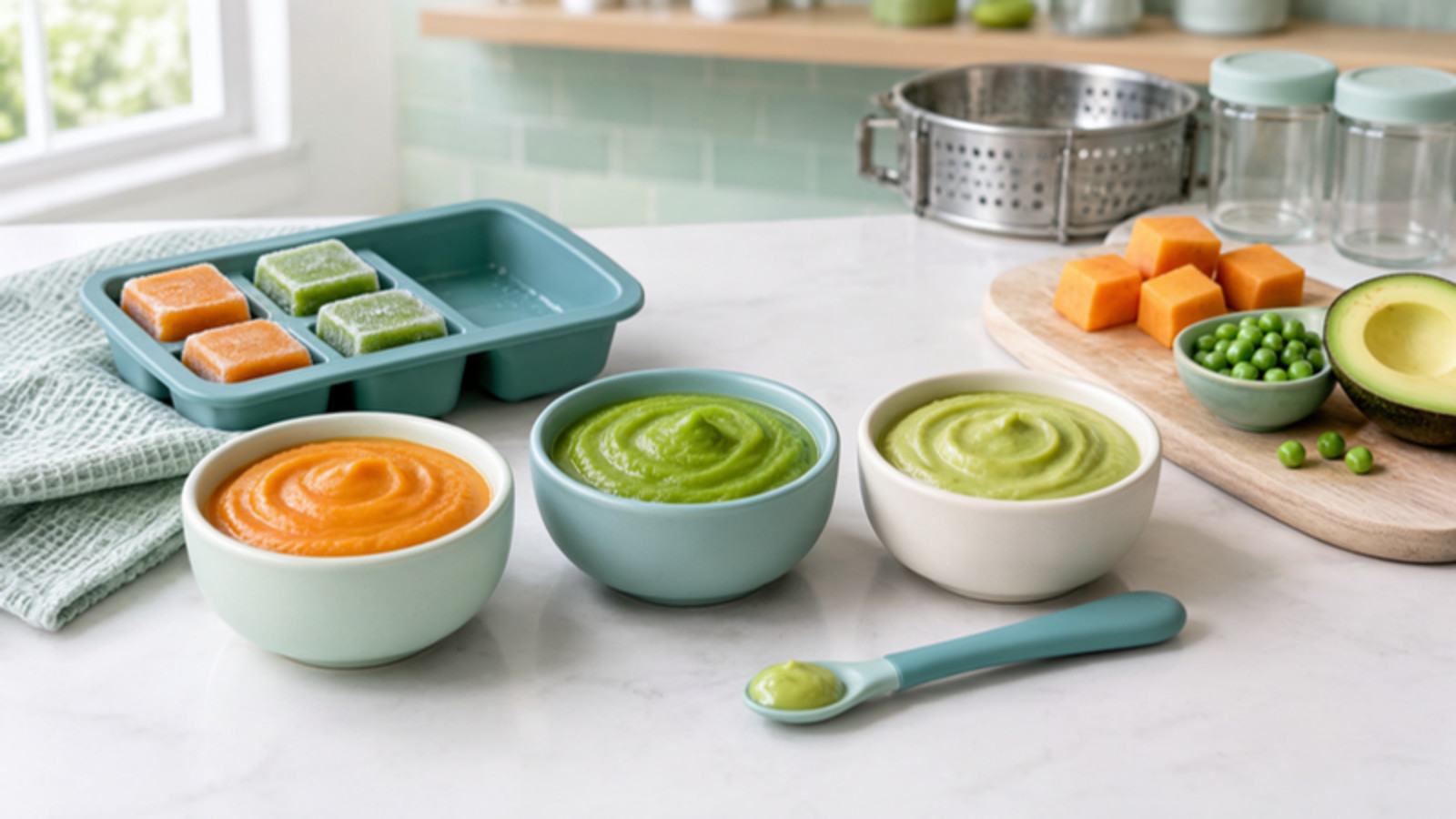
To freeze purees, the AAP suggests the ice cube tray method:
- Spoon the cooled puree into a clean ice cube tray. Each cube holds about 1 ounce.
- Cover the tray and freeze until solid.
- Pop the cubes into a freezer bag or container, and label it with the food and the date.
- Use frozen baby food within 3 months.
A few safety rules:
- Thaw frozen cubes in the refrigerator overnight, or in a sealed bag under cold running water, never on the counter.
- Never refreeze baby food that has been thawed.
- Don’t feed your baby straight from the storage container. Saliva on the spoon lets bacteria grow in the leftovers.
- If you reheat in the microwave, stir well and check the temperature, because microwaves heat unevenly.
- When in doubt, throw it out.
Is a baby food maker worth it?
A baby food maker is an all-in-one machine that steams food and then blends it in the same jar. Some can also defrost and reheat. It isn’t necessary, since the AAP says a blender, food processor or handheld mixer is enough. But it can be worth it for some families.
It may be worth buying if:
- You plan to make most of your baby’s purees at home for several months
- You want fewer pots and dishes to wash
- You’d like to steam and blend small batches quickly, without watching the stove
- You expect to use it again for a younger sibling
You can probably skip it if:
- You already have a good blender or food processor and a steamer basket
- You plan to mostly follow baby led weaning with soft finger foods
- You’ll mix homemade food with store-bought jars and pouches
- Counter space in your kitchen is tight
Whichever you choose, look for parts that come apart easily for cleaning and are made of glass or BPA-free plastic. For the gear that helps most before solids start, see our baby must-have list for the first 6 months.
From a Dad of Two: what worked for us
When we started solids, one of the most useful things we had in the kitchen was the Philips Avent 4-in-1 baby food maker. It steamed the food and then blended it, so the food was ready to give to the baby. It can also defrost and reheat, which helps if you freeze batches ahead of time.
Both of our kids were breastfed until about 14 months, so for us purees always came alongside breast milk, never instead of it.
Foods and ingredients to avoid in homemade baby food
- Honey: The CDC warns that honey can cause botulism, a serious type of food poisoning, in babies under 12 months. Don’t add it to purees, cereal or anything else.
- Salt: Don’t add salt to your baby’s food. Take your baby’s portion out before you season the family meal, and skip salty canned foods and processed meats.
- Added sugar: Fruit gives purees plenty of natural sweetness. The CDC advises avoiding foods with added sugars for young children.
- Juice: Offer pureed whole fruit instead. The AAP notes that some fruit juices can contain concerning levels of heavy metals.
- Cow’s milk as a drink: Wait until 12 months. Yogurt, cheese, and cow’s milk cooked into food are fine before then.
- Choking hazards: The AAP lists nuts, raw carrots, whole grapes, popcorn and seeds as choking hazards. Always puree or mash firm foods well.
- Homemade formula: Never make infant formula at home, and don’t let homemade food replace breast milk or formula.
One more note: Mayo Clinic advises against home-prepared spinach, beets, carrots, green beans or squash for babies younger than 4 months, because these vegetables can contain nitrates. Since solids usually start around 6 months, this mainly matters if your baby was advised to start early.
Does homemade baby food have fewer heavy metals?
Not necessarily. Metals like arsenic and lead come from soil and water, so they can turn up in any food, whether you buy it or make it. The AAP says serving a variety of foods is one of the best ways to lower exposure, and that variety matters just as much for homemade baby food. A few practical tips:
- Rotate vegetables instead of serving sweet potato or carrots every day.
- Use oat or multigrain cereals rather than only rice cereal.
- Choose whole fruit over juice.
- If you use well water, ask your local health department about testing it.
Homemade or store-bought: which is better?
Both are fine. Homemade baby food lets you choose the ingredients, can cost less and helps your baby get used to the foods your family eats. Store-bought jars and pouches are convenient and keep longer before they’re opened. Many families do both: homemade on most days, and jars or pouches for travel and busy weeks.
When to call the doctor
Call 911 or get emergency care right away if your baby shows signs of a serious allergic reaction after eating, such as:
- Hives all over the body
- Swelling of the lips, face or tongue
- Wheezing, hoarseness or trouble breathing
- Repeated vomiting or sudden sleepiness
Call your pediatrician if your baby gets a mild rash, vomiting or diarrhea after a new food, keeps refusing solids, has trouble swallowing or often gags and chokes, or isn’t gaining weight as expected. Nemours KidsHealth also advises not offering a food again after any reaction until you’ve talked with your doctor.
Frequently Asked Questions About Homemade Baby Food
How do you make homemade baby food?
Wash the food, peel it and remove any seeds, then cook it until very soft by steaming or microwaving. Blend it with a little breast milk, formula or water until smooth. Start with single foods, then try mixes. Serve what your baby will eat now and refrigerate or freeze the rest right away.
How long does homemade baby food last in the fridge?
Use fruit and vegetable purees within about 2 days, and meat or egg purees within 1 day, according to university extension food safety guides. Keep them in a covered container, and don’t put back any food that your baby’s spoon has touched.
Can you freeze homemade baby food?
Yes. Freeze purees in an ice cube tray (each cube holds about 1 ounce), then move the cubes to a labeled, dated freezer bag. The AAP says to use frozen baby food within 3 months. Thaw it in the fridge or under cold running water, and never refreeze thawed food.
Is a baby food maker worth it?
It isn’t necessary, because a blender or food processor plus a steamer basket does the same job. A steamer-blender combo can save time and dishes if you plan to make purees often. If you’ll only make them now and then, your regular kitchen tools are enough.
What are the best first foods to make at home?
Good first purees include sweet potato, peas, butternut squash, avocado, banana, pears and apples. Add iron-rich foods early, such as pureed meat, lentils or iron-fortified oat cereal, because babies need more iron from food starting around 6 months.
Is homemade baby food healthier than store-bought?
Not automatically. Making food at home lets you choose the ingredients and skip added salt and sugar, but testing has found trace heavy metals in both homemade and store-bought purees. The AAP’s main advice is the same either way: offer a wide variety of foods.
The Bottom Line
Making baby food at home is simple: cook it soft, blend it smooth, start with single foods and store it safely. You don’t need special equipment, although a steamer-blender can make things easier if you’ll cook often. Skip honey, salt and added sugar, offer plenty of variety, including iron-rich foods, and move toward thicker textures over the next few months. Homemade, store-bought or a mix of both are all good choices.
This article is for general information and isn’t a substitute for medical advice. Always contact your pediatrician with questions about your baby’s health.
10 Sources
Newborn Stages uses trusted sources, including government health agencies, children’s hospitals and pediatric organizations, to support the facts in our articles. Read our editorial policy to learn how we research, fact-check and keep our content accurate.
- HealthyChildren.org, American Academy of Pediatrics. Is it OK to make my own baby food?.
- HealthyChildren.org, American Academy of Pediatrics. Starting solid foods.
- HealthyChildren.org, American Academy of Pediatrics. Heavy metals in baby food: reducing risk of exposure.
- Centers for Disease Control and Prevention. Foods and drinks to avoid or limit.
- WIC Breastfeeding Support, U.S. Department of Agriculture. Starting solid foods.
- Mayo Clinic. Solid foods: how to get your baby started.
- Nemours KidsHealth. Feeding your 4- to 7-month-old.
- Cleveland Clinic. From the jar or blender: which baby food is best?.
- University of Maine Cooperative Extension. Bulletin #4309, making your own baby food.
- North Dakota State University Extension. Safe food for babies and children: making homemade baby food for babies 6 months and older.