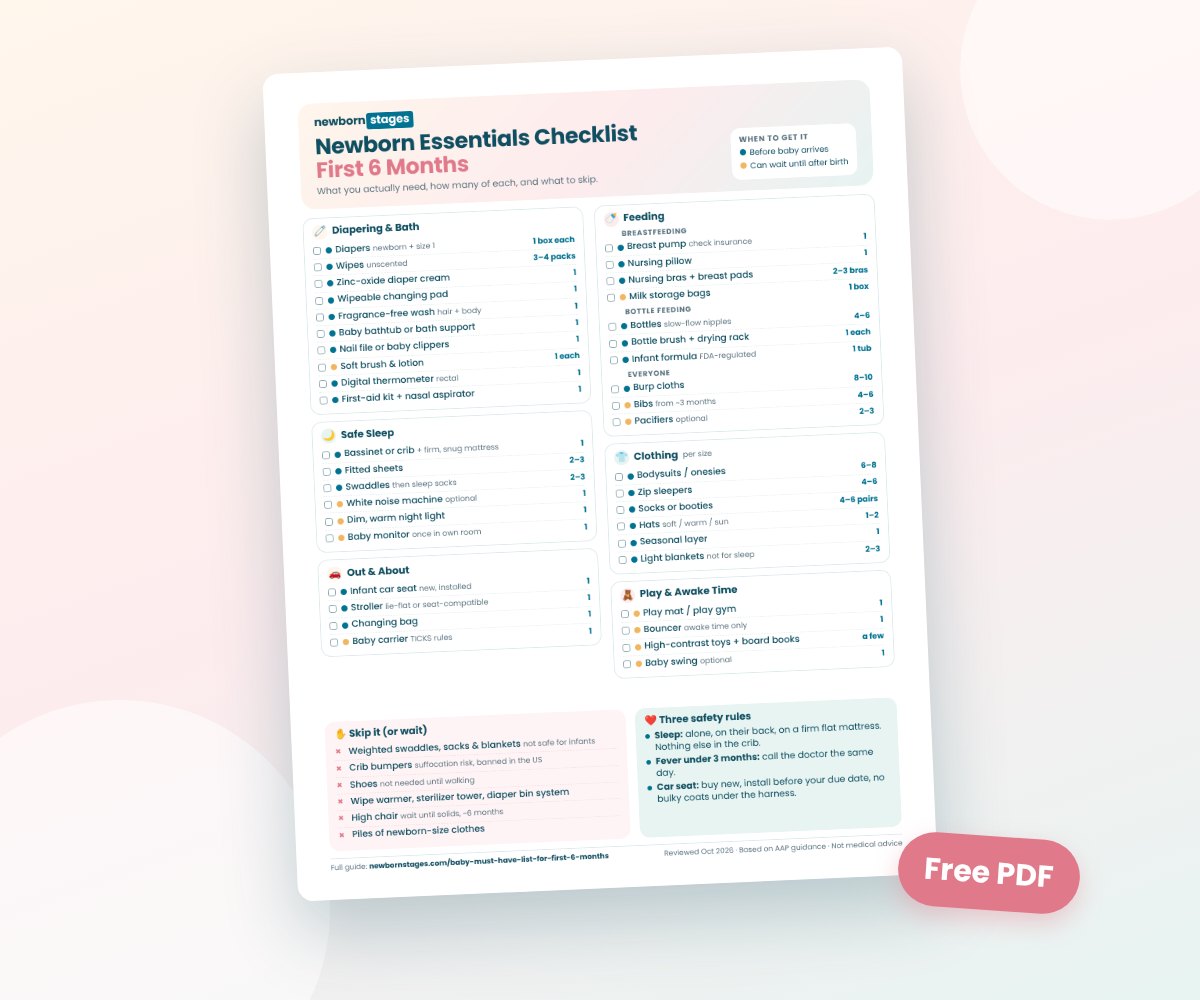



Last reviewed: November 6, 2026. Checked against current guidance from the American Academy of Pediatrics (HealthyChildren.org) and the CDC.
Quick answer: The AAP recommends that your baby sleeps in your room, but in their own crib or bassinet, ideally for at least the first 6 months. Room-sharing is linked to a lower risk of SIDS, but bed-sharing is not safe: your baby should never sleep in your bed, on a sofa or in an armchair. After 6 months, moving your baby to their own room is a personal choice, and a gradual transition makes it easier.
Wanting your bedroom back after the newborn weeks is completely understandable. Here’s what the safe sleep guidance actually says, why room-sharing matters in the early months, and how to move your baby to their own room when you’re ready.
Why Room-Sharing Is Recommended for the First 6 Months
About 3,400 babies in the US die suddenly and unexpectedly each year, most often during sleep, according to the Centers for Disease Control and Prevention (CDC). Some of these deaths are SIDS, and others are from accidental suffocation in unsafe sleep spaces.
The AAP recommends room-sharing without bed-sharing because having your baby close by lowers the risk of SIDS and makes night feeds and checks easier. The safest setup is:
- A crib, bassinet or play yard that meets safety standards, placed close to your bed
- A firm, flat mattress with a fitted sheet and nothing else in it: no pillows, blankets, bumpers or toys
- Your baby placed on their back for every sleep
Bed-sharing is not recommended. The AAP advises against sharing a bed with your baby, and never sleeping with a baby on a sofa, couch or armchair, which carries the highest risk. Bedside sleepers that attach to an adult bed haven’t been studied enough to recommend.
Can a Baby Sleep in Their Own Room From Birth?
It isn’t recommended in the first months. A baby in a separate room can’t be heard or checked as easily, and the protective effect of room-sharing is strongest in the first 6 months, when the risk of SIDS is highest. If your home layout makes room-sharing truly impossible, talk to your pediatrician about the safest setup for your family.
When to Move Your Baby to Their Own Room
The AAP’s current advice is to room-share ideally for at least the first 6 months. After that, the timing is up to you. Some families move their baby at 6 months, others closer to a year. Some research suggests babies may sleep longer stretches in their own room after the early months, but the right time depends on your baby, your home and how everyone is sleeping.
How to Transition Your Baby to Their Own Room
1. Start With Daytime Naps
Put your baby down for one or two naps a day in their new crib. This helps them get used to the room in daylight, when it feels less strange.
2. Spend Awake Time in the New Room
Use the nursery for diaper changes, feeds, reading and play, so it becomes a familiar, calm place.
3. Keep the Same Bedtime Routine
A short, predictable routine signals that sleep is coming. For example: bath, pajamas and a sleep sack, a feed, a book or song, then into the crib drowsy but awake. Keep the room dark, quiet and comfortably cool.
4. Use a Baby Monitor
An audio or video monitor lets you hear and see your baby from your room. Monitors are for peace of mind, though: no monitor has been shown to prevent SIDS.
5. Comfort Them Through the Change
Some babies protest at first. That’s normal. You can sit with them, pat or shush them, or pick them up to settle them, then put them back down on their back in the crib.
6. Keep the Crib Safe
The same rules apply in the new room: back to sleep, firm flat mattress, nothing else in the crib, and a sleep sack instead of blankets. Our guide to SIDS and safe sleep covers every step.
The Bottom Line
For the first 6 months, the safest place for your baby to sleep is in your room, in their own crib or bassinet, on their back, with nothing else in the sleep space. Never share a bed or fall asleep with your baby on a sofa. After 6 months, you can move them to their own room whenever it suits your family, ideally starting with naps and keeping the same calm routine.
This article is for general information and isn’t a substitute for medical advice. Always contact your pediatrician with questions about your baby’s sleep.
4 Sources
Newborn Stages uses trusted sources, including government health agencies, children’s hospitals and pediatric organizations, to support the facts in our articles. Read our editorial policy to learn how we research, fact-check and keep our content accurate.
- HealthyChildren.org, American Academy of Pediatrics. How to keep your sleeping baby safe: AAP policy explained.
- HealthyChildren.org, American Academy of Pediatrics. Safe Sleep: Back is Best, Avoid Soft Bedding, Inclined Surfaces & Bed Sharing.
- Centers for Disease Control and Prevention. Data and statistics for SUID and SIDS.
- Pediatrics (Paul IM et al., 2017), via Penn State. Mother-Infant Room-Sharing and Sleep Outcomes in the INSIGHT Study.