


Last reviewed: November 6, 2026. Checked against current guidance from the CDC and Children’s Healthcare of Atlanta.
For toddlers, fine motor skills are very important to develop as they are at an age where they need to develop their synchronization with their muscles.
Why Are Fine Motor Skills Important For Toddlers?
As a child grows, they need to develop certain skills to keep up with their cognitive development. Fine motor skills are one that a toddler has to develop with time.
It helps a child perform certain tasks by themselves. Some of them include grasping an object, eating, writing, and many more.
In addition, the synchronization between a child’s eyes, hands, and brain are developed through fine motor skills.
Fine motor skills develop small muscle movements and enable a child to learn how to carry out things. For example, as they grow up, toddlers try to do things by themselves, which is when the fine motor skills come in help and enable them to do it.
Benefits of Fine Motor Skills
Fine motor skills are now essential that every child should be taught. There are many benefits that a parent can see their child having. For example, a toddler doing things themselves results in fine motor skills.
Therefore, it is important to know the countless benefits that a toddler can enjoy after grasping fine motor skills.
- Enables a toddler to play and grasp objects
- Boosts confidence
- Helps in developing communication skills
- Improves creativity
- Hand-eye coordination gets better
- Control and coordinate their body
These are just some of the common benefits you will start seeing in your child. Fine motor skills help in many other ways as well.
Fine Motor Skills Examples For Toddlers
You may have heard about fine motor skills and have a piece of good knowledge. But still, confused about what they are? Don’t worry; here we are with some of the best examples of fine motor skills to help you get a better understanding.
Fine motor skills are just some things that we do daily. You wouldn’t even know that, but yes, they can be a way to teach your kid fine motor skills. Some of the examples of fine motor skills to teach your child includes:
- Picking up objects and then putting them down
- Stringing large beads (around age 3)
- Shaking musical instruments
- Playdough
- Brushing teeth
- Clapping
- Taking off and putting on loose clothes and shoes
- Grabbing a crayon
- Turning doorknobs and unscrewing lids
All these are some examples of fine motor skills. If your child starts doing some of these things, they are learning fine motor skills. Harder skills like opening and closing large buttons usually come around age 4, and tying shoelaces comes later still.
Scientific evidence suggests a link between brain development and fine motor skills.
How to Know If A Toddler is Developing Fine Motor Skills?
You may have done everything but still thinking if your child has developed fine motor skills or not. However, some signs would reflect that the child is developing fine motor skills.
All you need to do is observe their behavior properly, and if the signs mentioned below are shown, you have successfully taught your child fine motor skills.
Block Tower
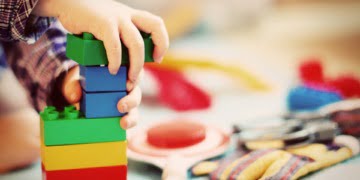
You need to put some blocks in your child’s playroom. Leave them around it, and if they start building a block tower, it is one of the signs to let you know. According to Children’s Healthcare of Atlanta, many toddlers stack 3 to 4 blocks by 18 months and about 6 blocks by age 2.
Scribbling
Scribbling is one of the favorite things that toddlers do. Be it on a paper or a wall, a toddler with developed fine motor skills will start scribbling all over the place. Most children scribble by 18 months. What they are drawing wouldn’t make sense, but their grip over the pencil is one of the signs.
Eating
Your toddler feeding themselves with a spoon is a great way to understand if they are developing fine motor skills or not. The CDC says most toddlers try to use a spoon by 18 months and eat with a spoon by age 2. It may take some time for the child to hold and get a good grip over the spoon, but eventually, they will.
It is okay if they drop the food; practice makes a man perfect. Just let them eat by themselves.
Pincer Grasp
A pincer grasp means picking up small items between the thumb and pointer finger, like a small bit of food. Most babies can do this by their first birthday, so by the toddler years it should be getting stronger and more precise. As Children’s Healthcare of Atlanta notes, holding a crayon between the thumb and pointer finger comes later, often around age 4.
Activities to Carry Out to Develop Fine Motor Skills
It is a challenging task to carry out. Fine motor skills by the name can be confusing, but all it takes are efforts from your side. You need to spend a good amount of time with your child and carry out the activities mentioned below.
Other than developing fine motor skills, these activities are a fun way to have some fun time with your child. Some of the activities include
- Finger painting
- Puzzles
- Simple games with large, chunky pieces (small game pieces and dice are choking hazards for children under 3)
- Stacking cups or rings on a post
- For Playdough and clay activities, make sure to use a cookie-cutter
- Make your child a part of your kitchen, especially when you are cooking something
- Teach them to use large plastic tongs to pick up toys or pom-poms that are too big to choke on
- Set the dinner table with your child
Always supervise these activities. Keep small objects, rubber bands and balloons away from children under 3, because they can cause choking. All these activities will show that your child is developing fine motor skills. It may take some time but be patient as your efforts will start showing results.
Final Words
This was your complete for examples of fine motor skills and some of the common questions parents have regarding fine motor skills.
Fine motor skills are essential for cognitive development and learning. Make sure to learn more about fine motor skills as it is a major skill that a child should possess at an early age.
This is something every parent should take seriously. If you are worried about your child’s fine motor skills, talk to your pediatrician. Children under 3 can also get a free evaluation through your local early intervention program, and you don’t need a doctor’s referral.
This article is for general information and isn’t a substitute for medical advice. Always contact your pediatrician with questions about your baby’s health.
5 Sources
Newborn Stages uses trusted sources, including government health agencies, children’s hospitals and pediatric organizations, to support the facts in our articles. Read our editorial policy to learn how we research, fact-check and keep our content accurate.
- Children’s Healthcare of Atlanta. Fine motor skills.
- CDC. Milestones by 18 Months.
- CDC. Milestones by 2 Years.
- CDC. Milestones by 3 Years.
- CDC. Concerned About Your Child’s Development?.